Do You Have to Wait for the Adjuster Before Drying Starts in Florida?

BYSteve Jafari, General ManagerMIAMI-DADE & BROWARD
Usually not for emergency work. Florida's Homeowner Claims Bill of Rights advises policyholders to make and document emergency repairs necessary to prevent further damage, to photograph damage before and after any repairs, and to keep receipts. Nothing in it tells you to wait for an adjuster. Some policies cap emergency costs, require notice before repairs, or restrict permanent repairs, so report the claim and check whether your policy has terms like these.
Call (786) 213-9489Do you have to wait for the adjuster before drying starts in Florida?
Usually not for emergency work. Florida's Homeowner Claims Bill of Rights, the plain-language summary an insurer issuing personal lines residential property policies in Florida must provide within 14 days after receiving an initial communication about a claim, advises policyholders to "Make and document emergency repairs that are necessary to prevent further damage." Nothing in it tells you to wait for an adjuster before doing that.
Emergency work and permanent repairs are different things, and the limits live in the difference. Some policies cap what they pay for emergency measures, some require notice to the insurer before repairs start, and some have restricted permanent repairs until the insurer has had a chance to look. Report the claim, then check whether your policy has terms like these before work goes past the emergency.
Restoration Doctor is a water mitigation company, not a public adjuster, a law firm or an insurance company. Nothing here is legal advice or insurance advice, and nothing here describes what your policy requires of you. Your policy and Florida law govern your claim.
What does the Homeowner Claims Bill of Rights advise?
Fla. Stat. 627.7142 sets out the text insurers must deliver, and its stated purpose is "to summarize, in simple, nontechnical terms, existing Florida law". Three of its seven advisory items bear on the first hours of a water loss.
Item 1: "File all claims directly with your insurance company." Item 3: "Make and document emergency repairs that are necessary to prevent further damage. Keep the damaged property, if feasible, keep all receipts, and take photographs or video of damage before and after any repairs to provide to your insurer." Item 7: "Take precautions if the damage requires you to leave your home, including securing your property and turning off your gas, water, and electricity, and contacting your insurance company and provide a phone number where you can be reached."
Two limits on reading it. The same statute says the Bill of Rights "does not create a civil cause of action by an individual policyholder", and it "does not enlarge, modify, or contravene statutory requirements". It is advice the state requires insurers to hand you, not a rewrite of your policy.
Why does timing matter on a South Florida water loss?
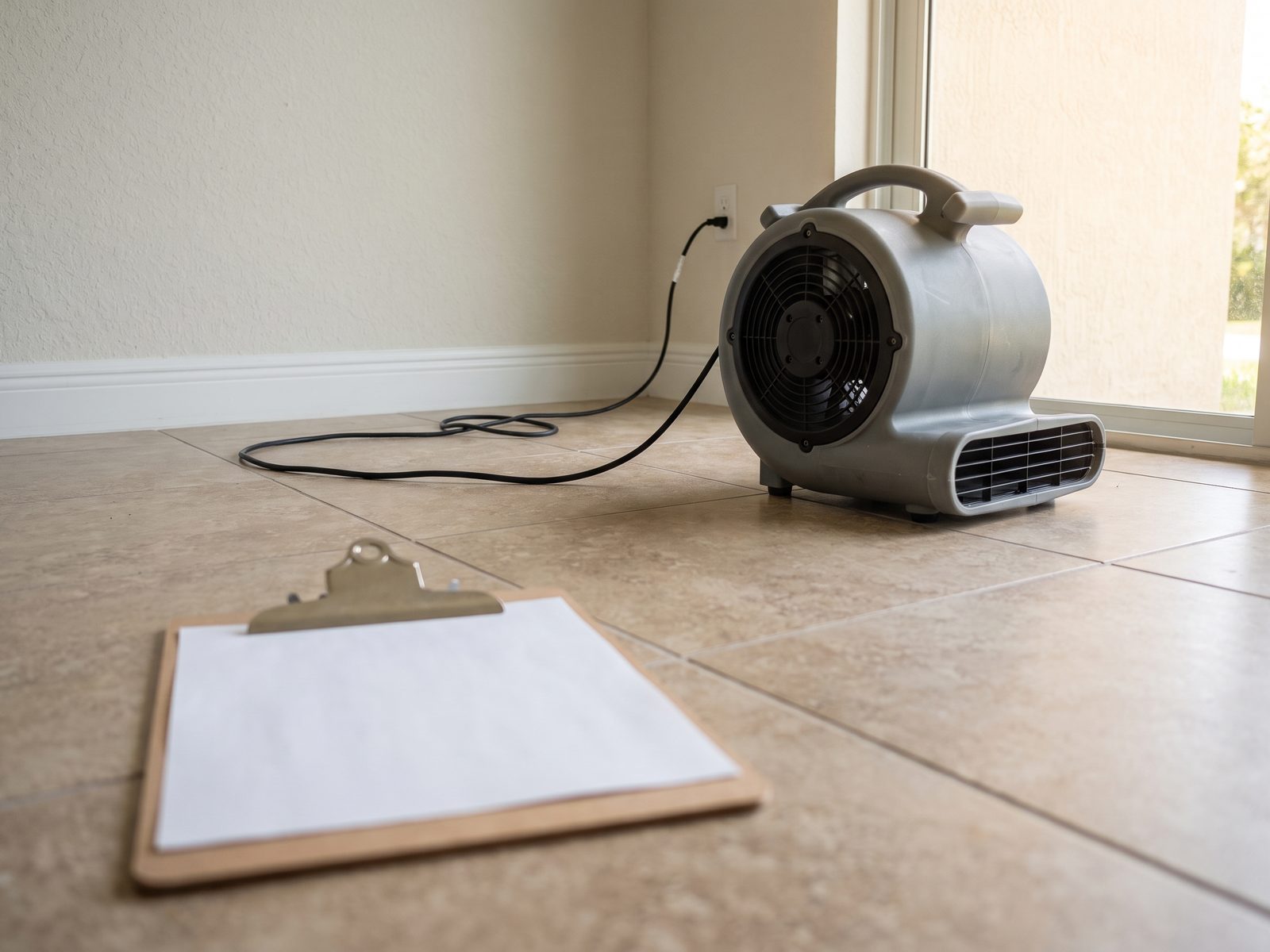
Because wet materials do not get a grace period here. Wet gypsum, framing and insulation stay wet until something removes the water, and the humidity outside works against drying the whole time. That is why our crews start drying the same day the water does.
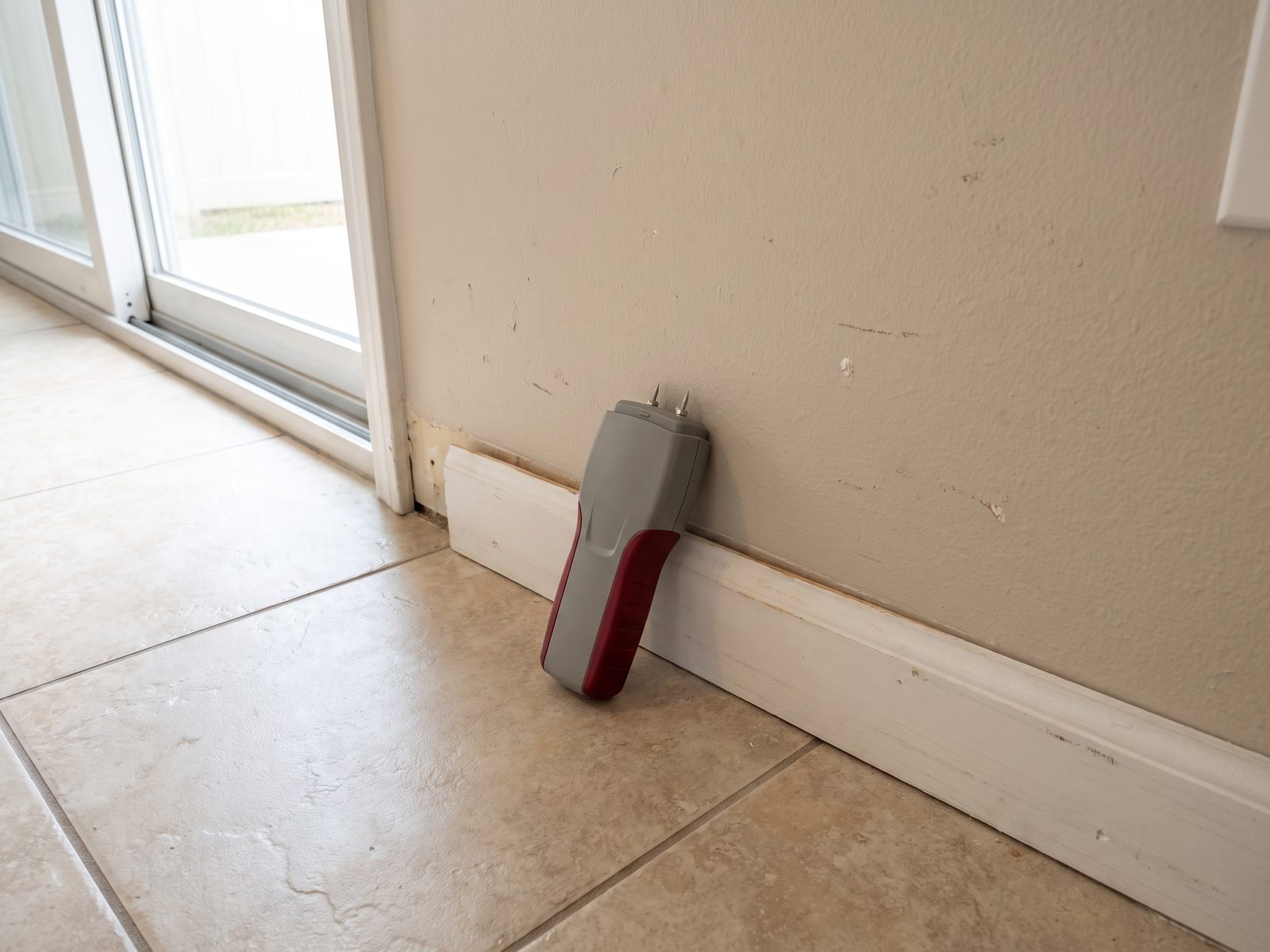
It is also why the first thing on site should be a record. Our crews keep time-stamped photos, moisture maps, psychrometric logs and a line-item scope, written down as the work happens, so that what was wet on arrival is documented before material leaves the building.
How long can the insurer's side take?
The clocks Florida sets for the insurer run in days, not hours. The Bill of Rights says you have the right to an acknowledgment of your reported claim "within 7 days". Fla. Stat. 627.70131(3)(b) says: "An insurer must conduct any such physical inspection within 30 days after its receipt of the proof-of-loss statements."
Florida's Office of Insurance Regulation, in its Property Insurance Stability Report of July 1, 2026, says "the average number of days for insurers to close a claim is 66 days", with a median of 30 days. Those are market-wide figures for all perils. They are a fair picture of why emergency drying and the claim run on two different schedules.
Do some policies cap emergency costs?
Yes, and Citizens publishes its own. Its FAQ on emergency measures, updated July 27, 2026, says: "If you're eligible for and consent to Citizens' free emergency water removal services, the $3,000 cap does not exist." But "If you perform emergency water removal services, for a coverage loss, outside of the Citizens' program," then "no additional costs over the $3,000 cap will be covered."
A second Citizens FAQ, updated August 18, 2026, adds that for HO-3 and DP-3 policyholders who do not participate in its managed repair program, "nonweather water-related losses will be subject to a $10,000 limit", and "payments made from the $3,000 reasonable emergency measures limit will be deducted from the $10,000 water limit."
Citizens' 2025 personal lines form bulletin, dated October 2, 2025, describes reasonable emergency measures coverage as one that "Must be strictly limited to immediate actions taken to protect covered property from further damage."
Those are Citizens' published descriptions of its own forms. Other insurers write their own terms. If you hold a Citizens policy, ask Citizens whether its free emergency water removal program is available to you before you choose who extracts the water.
| Citizens source | What it says |
|---|---|
| FAQ 3930 (updated July 27, 2026) | Through Citizens' free emergency water removal, where eligible, "the $3,000 cap does not exist"; outside it, "no additional costs over the $3,000 cap will be covered" |
| FAQ 3933 (updated Aug. 18, 2026) | Non-participants: "$10,000 limit" on non-weather water; emergency payments "deducted from the $10,000 water limit" |
| 2025 Personal Lines Form Changes (Oct. 2, 2025) | Emergency measures "Must be strictly limited to immediate actions taken to protect covered property from further damage" |
Can a policy require notice before work starts?
Some do. In People's Trust Insurance Co. v. Nowroozpour, No. 4D21-720 (Fla. 4th DCA Nov. 24, 2021), the policy's endorsement said the insureds "must notify People's Trust before authorizing or commencing repairs so that People's Trust may select Rapid Response Team, LLC ('RRT') to make the covered reasonable repairs." The court described the insurer's promise of that contractor "within 48 to 72 hours".
Under a clause like that, the order of the calls matters. The Bill of Rights gives the same advice in general terms: "Contact your insurance company before entering into any contract for repairs". Whether your policy has such a clause is a question for your insurer or your agent.
What about permanent repairs before the adjuster comes?
That is where the waiting rules have lived. Citizens' 2025 form bulletin says "The 72-hour repair restriction has been removed from:" its CIT HO-3, HO-6 and DP-3 forms for "new and renewal policies effective December 1, 2025."
Read the dates carefully. The change applies to new and renewal policies from that date. In our reading, a policy term that began earlier may still carry the older wording until it renews. Which wording applies to one policy is a question for the insurer. The broader point holds for any insurer: emergency drying and permanent repairs are treated differently, and the first is the one the Bill of Rights advises you to make and document.
What should you document before materials leave?
The Bill of Rights answers most of this in its own words: photographs or video of damage before and after any repairs, all receipts, and the damaged property itself if feasible. The rest is ordinary good practice that makes the record checkable later.
- Photograph or video every affected room before anything is moved or removed, and again after.
- Keep all receipts, as the Bill of Rights advises.
- Keep removed material if feasible, or at least photograph it with something that shows its size.
- Ask your mitigation company for its moisture readings and photographs, and keep a copy yourself.
- Write down when you reported the claim, to whom, and the claim number you were given.
- Ask your insurer in writing whether your policy has an emergency measures limit, a managed repair program or a notice requirement, and keep the answer.
- For help with a claim, the Bill of Rights points to the toll-free helpline of the Florida Department of Financial Services, Division of Consumer Services.
What will a Florida contractor not tell you, and what is our view?
A contractor will not tell you what your policy requires of you, and in Florida it should not. Fla. Stat. 489.147(2)(d) bars a contractor without a public adjuster license from "Interpreting policy provisions or advising an insured regarding coverages or duties" under the policy. That is why this post quotes the state's advice and Citizens' published terms, and leaves your own policy to your insurer and your agent.
How we work: we invoice the property owner, and you pay us under the agreement you sign, whether or not your insurer pays. We give you a complete file, with photographs, moisture readings and an itemized invoice, to submit with your claim. What your insurer pays is set by your policy.
Our view, as a drying company: water damage grows while it waits, so the emergency phase should not wait on a schedule that runs in days. That view is about buildings, not about your policy, which may limit what it pays for emergency work or who does it. Check those terms first, then let the drying start.
Where can I read the authorities for myself?
Every quotation above came from the sources below, read on the publishers' own sites on November 21, 2026. Statutes and insurer FAQs change, so confirm the current text before relying on any of it. For a question about one specific policy, a licensed Florida public adjuster or attorney is who answers it.
| Source | Link |
|---|---|
| Fla. Stat. 627.7142, Homeowner Claims Bill of Rights | Fla. Stat. 627.7142 |
| Fla. Stat. 627.70131(3)(b), inspection within 30 days of proof-of-loss | Fla. Stat. 627.70131 |
| Fla. Stat. 489.147(2)(d), contractors may not interpret policies | Fla. Stat. 489.147 |
| Citizens FAQ 3930, the $3,000 emergency water removal cap (updated July 27, 2026) | Citizens FAQ 3930 |
| Citizens FAQ 3933, the $10,000 limit for non-participants (updated Aug. 18, 2026) | Citizens FAQ 3933 |
| Citizens, 2025 Personal Lines Form Changes (Oct. 2, 2025) | Citizens 2025 form changes |
| People's Trust Ins. Co. v. Nowroozpour, No. 4D21-720 (Fla. 4th DCA Nov. 24, 2021) | Nowroozpour opinion (PDF) |
| Florida OIR, Property Insurance Stability Report, July 1, 2026 | OIR report (PDF) |