Restoration Company in South Florida
Water, storm, mold, sewage, fire and contents restoration for homes, condos and commercial property across Miami-Dade, Broward and Palm Beach, dispatched 24/7 from our Brickell office.
Emergency line 786-213-9489, answered by a person 24 hours a day across Miami-Dade, Broward and Palm Beach.
If the loss is active right now, read what happens after an emergency call — the first hour, step by step.
Who we are, and where we work from
Restoration Doctor of South Florida is a restoration company in South Florida built around one office and one accountable crew list. The office is at 1200 Brickell Ave Suite 1950 #1007, Miami, FL 33131, and the line is (786) 213-9489. Trucks stage in the Brickell corridor and run north on I-95 and Florida's Turnpike into Broward and Palm Beach, so a call from Aventura, Fort Lauderdale or Boca Raton reaches the same dispatcher and the same equipment inventory as a call from three blocks away. The phone is answered by a person, and it is answered at 3 a.m.
Our crews work to the IICRC standards that actually govern this trade: ANSI/IICRC S500 for water damage restoration, S520 for mold remediation, S700 for fire and smoke. That is not decoration on a marketing page. S500 is the document that says clean Category 1 water degrades toward Category 2 contamination in roughly 48 hours, and in a region that sits at 70 to 80 percent relative humidity for most of the year, that clock is the entire job. A crew that treats a Miami loss like a Denver loss hands you a mold project three weeks later.
Dispatch runs 24 hours a day, seven days a week, including the week a named storm makes landfall. A crew is typically on-site within 60 minutes in Miami-Dade. Broward and Palm Beach dispatches take somewhat longer. We publish a number rather than the word fast because a number is the only version a customer can hold us to. Restoration Doctor of South Florida is the Florida operation of the multi-state Restoration Doctor group headquartered in Vienna, Virginia. The equipment depth and the documentation discipline come from that group. The crew that walks through your door is local, and the office you can drive to is in Brickell.
Every loss type, one project file
A restoration company in South Florida has to be competent across every major loss type, because down here the losses arrive stacked on top of each other. A hurricane pushes water past a window seal, the water sits for two days while the power is out, and by the time anyone opens the unit it has become a mold job. A kitchen fire is extinguished with several hundred gallons of water, and the smoke damage and the water damage have to be scoped as one loss or the file falls apart. Everything below runs out of the same Brickell dispatch, under one project number and one documentation file.
Water damage restoration
Emergency extraction, structural drying and moisture verification after supply-line breaks, drain-stack failures, water-heater ruptures, air-handler overflows and the unit-to-unit migration that defines high-rise losses. Tile over concrete slab and wood-frame construction dry on completely different curves, so the drying plan is built from meter readings rather than a fixed number of days.
Water damage restoration detailsStorm and hurricane damage restoration
Emergency board-up, roof tarping and drying after wind-driven rain, storm surge, roof intrusion and sliding-door seal failures. Hurricane work has to be scheduled around utility restoration and building access, and the loss file is built to survive the extra scrutiny a named-storm claim attracts.
Storm and hurricane damage restoration detailsMold remediation
Containment, negative air, HEPA filtration and controlled removal under IICRC S520, followed by independent third-party verification that the work is finished. South Florida grows mold on a timeline the rest of the country never has to plan for. An air conditioner switched off for a week in August is enough to start one.
Mold remediation detailsSewage and biohazard cleanup
Category 3 losses, from a backed-up drain stack on the ninth floor of a condo tower to a lift-station failure at a commercial property. Full PPE, controlled removal of porous materials, antimicrobial application, disposal documentation and verification before anything gets rebuilt.
Sewage and biohazard cleanup detailsFire and smoke damage restoration
Soot and smoke residue removal, structural cleaning and odor neutralization to IICRC S700, including the suppression-water half of the loss that a fire-only contractor will happily leave wet behind the drywall for mold to find later.
Fire and smoke damage restoration detailsContents restoration and pack-out
Inventoried pack-out, cleaning, climate-controlled storage and pack-back. In this climate, contents left inside a wet building become a second loss within a week, so the pack-out decision gets made on day one rather than day five.
Contents restoration and pack-out detailsReconstruction and repairs
Drywall, baseboard, trim, cabinetry, flooring and paint once materials verify dry, coordinated with your association's access rules and work hours. One company from the first extraction through the final coat of paint means there is no seam where two contractors get to blame each other.
Talk to us about the rebuildMiami-Dade, Broward and Palm Beach
12 published city pages across three counties, all dispatched from one Brickell office.
South Florida is three counties and roughly six million people packed onto a strip of limestone between the Everglades and the Atlantic. We cover all three: Miami-Dade, Broward and Palm Beach. The real constraint on a restoration company in South Florida is not distance, it is traffic and building access, which is why the fleet stages in Brickell and moves on I-95 and Florida's Turnpike instead of working out of a single warehouse at the edge of the metro.
Every city below has its own page with local neighborhood, housing-stock and water-risk detail, because a Key Biscayne oceanfront condo and a Pinecrest ranch house on a slab fail in completely different ways. If your city is not on the list, call anyway. We respond across all three counties today, and the page grid lags the coverage.
Miami-Dade County
Our home county. Brickell, downtown and the Miami Beach barrier island are high-rise territory, where one riser failure runs down four floors and involves an association, a management company and several owners at once. Coral Gables, Coconut Grove and Miami Shores are older single-family stock with wood framing and a mature tree canopy that turns into roof damage in a storm. Doral, Hialeah, Kendall and Homestead are newer slab-on-grade construction, where water travels laterally under tile instead of soaking down into a subfloor, which is exactly the loss people mop up and then discover six weeks later.
Broward County
Fort Lauderdale, Hollywood, Pompano Beach, Pembroke Pines, Plantation, Sunrise, Coral Springs and Weston. The Intracoastal and the canal grid put a large share of Broward housing at or barely above sea level, so a heavy king-tide week or a stalled summer storm produces losses that have nothing to do with a burst pipe. Broward is a straight run up I-95 from our Brickell office.
Palm Beach County
Boca Raton, Delray Beach, Boynton Beach, West Palm Beach, Jupiter and Wellington. Palm Beach adds a large inventory of gated communities and country-club associations with their own access procedures, insurance requirements and approved-vendor expectations, plus a coastal band carrying the same wind-driven rain exposure as the rest of the region. We reach most of the county on Florida's Turnpike faster than on I-95.
How to choose a restoration company in South Florida
Most people hire a restoration company in South Florida during the worst ninety minutes of their year, off a list of three names a neighbor texted them while the water was still running. Here is the short version of what to check. It takes about ten minutes, and it is the difference between a documented file and a lawsuit.
- 01
Look the company up on the Florida DBPR licensee search
Florida licenses contractors and several restoration specialties through the Department of Business and Professional Regulation, and the licensee search at myfloridalicense.com is free, public and takes two minutes. Ask which legal entity the license is issued to, then confirm that the entity name matches the name printed on the contract you are being asked to sign. Names that are close but not identical are the single most common problem in this trade, and it is the one that leaves a homeowner with no recourse.
- 02
Check the mold registration separately, if mold is involved
Florida is one of the few states that licenses mold assessors and mold remediators as separate registrations, and it bars the same company from both assessing and remediating the same job. Ask for the remediator number and look it up. Our Florida mold remediation is performed under Florida Mold Remediator registration MRSR5548, issued by the Florida Department of Business and Professional Regulation and Current · expires 07/31/2028. Independent third-party clearance testing, ordered by you rather than by us, is the correct way to confirm a mold job is actually finished.
- 03
Ask which IICRC standard the drying plan follows
The right answer is ANSI/IICRC S500 for water and S520 for mold, and the follow-up question is better: ask what the dry standard is. A competent restorer takes moisture readings from unaffected material of the same type elsewhere in the building, sets that as the target, and pulls equipment when the affected material reaches it. A company that tells you drying takes three days is quoting a calendar, not a standard, and in 80 percent humidity a calendar is worthless.
- 04
Confirm general liability and workers' compensation, in writing
Ask for a certificate of insurance emailed directly from the agent, not a photo of one. Uninsured crews cutting drywall in your unit are your problem the moment somebody gets hurt, and most condo associations will refuse building access without a current certificate naming the association as additional insured. Ask about that requirement before the truck is in the loading dock rather than after.
- 05
Insist on daily moisture documentation
Every day of drying should produce moisture readings on each affected material, psychrometric readings inside and outside the drying chamber, equipment run times and time-stamped photographs. If a company cannot show you yesterday's numbers today, it has no way of proving the building is dry and no way of proving to your carrier that the equipment days it billed were necessary. This is the part of the file that determines whether a claim settles cleanly.
- 06
Ask for the reading behind every removal
You should be able to see why a material is coming out: a moisture reading and a photograph taken before it is removed. We write the scope in Xactimate, the same line-item format adjusters price from, so your claim file can be read and checked line by line instead of arriving as a lump sum. Emergency stabilization starts immediately, and the readings and photos behind each removal go into your file.
- 07
Do not sign an assignment of benefits under pressure
An assignment of benefits hands your claim rights to the contractor, and Florida spent most of a decade legislating its way out of what that produced. Any company that will not start work until you sign one is telling you who its customer is. We do not ask for an AOB. You keep your claim, your file and your leverage, and nobody signs anything at 2 a.m. that they have not read.
- 08
Ask what happens during hurricane season
After a named storm, every restoration company in South Florida is oversubscribed within hours and equipment becomes the scarce resource, not labor. Ask whether the company stages equipment and generators before landfall, and whether it offers a pre-loss agreement that puts your building on a priority list. For property managers and associations, getting that on file in May is worth more than any phone call made the day after the storm.
How insurance works with us, and who we actually work for
This is the part of the industry that generates the complaints, so here is our model in plain terms. We invoice the property owner. You pay us, and we hand you a complete, carrier-ready claim file: an Xactimate line-item estimate in the format adjusters already price from, time-stamped photographs of every phase from arrival through verified dry-out, daily moisture and psychrometric logs, equipment run times, and a scope narrative that explains why each line exists. You submit that file to your carrier, and it is built specifically so that every line in it can be checked against the readings and photographs behind it.
The reason to structure it that way is that it settles the question of who the contractor answers to. When the carrier is the party paying the contractor, the contractor's next ten jobs depend on staying on that carrier's vendor list, and the scope quietly starts shrinking toward whatever the carrier prefers to pay for. We work for you, not the insurance company. If an adjuster disputes a line, we will document it and defend it with the readings and the photographs, but we are not sitting across the table negotiating our own fee with them while you wait outside.
We also do not ask homeowners to sign an assignment of benefits. Your claim stays yours. We give you the documentation that makes it defensible, and you stay the decision maker on your own loss, including on whether to file at all. If the loss is under your deductible and you are paying out of pocket, tell us on the first call. The scope conversation for an uninsured loss is a genuinely different one, and it is much better to have it before demolition than after.
One more thing worth saying out loud: an insurance carrier's preferred-vendor program exists to control the carrier's cost. That is a legitimate goal for the carrier and it is not the same as your goal. You are entitled to choose your own restoration company in South Florida, and you are entitled to a scope that returns the property to pre-loss condition rather than to the cheapest defensible approximation of it.
The claim file itself is built to the same standard everywhere in the company; if you want to see what goes into one before you call, read how Restoration Doctor documents an insurance claim.
What happens between your call and tomorrow morning
The first day decides how big the loss gets. Water that is extracted and under a drying system inside a few hours is a drying project. The same water left overnight in this climate is a demolition project, and left for a weekend it is a mold project. Here is what actually happens between your call and the end of the first 24 hours.
Minute 0, the call
A person answers (786) 213-9489, any hour, any day. We take the address, the building access requirements and what is still running, and we walk you through shutting off the water at the valve or killing power to the affected circuits before anyone arrives. That conversation alone routinely saves more square footage than the first hour of extraction.
Minute 60, crew on site in Miami-Dade
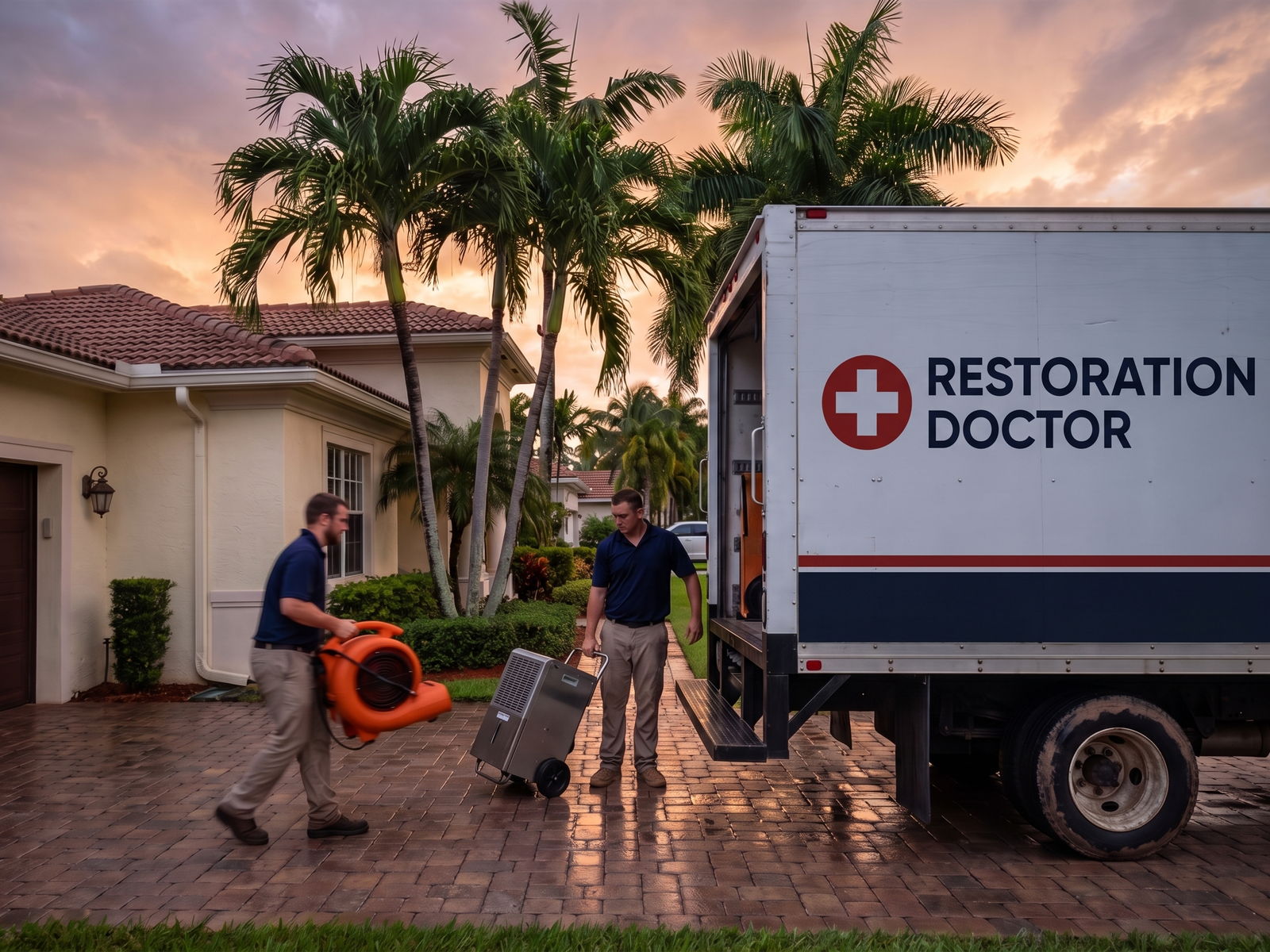
A crew is typically on-site within 60 minutes in Miami-Dade. Broward and Palm Beach dispatches take somewhat longer. The truck arrives with extraction units, air movers, dehumidifiers and air scrubbers already loaded, because a second trip across the metro in Miami traffic costs far more time than carrying the equipment costs in fuel.
Hour 1 to 3, stop, extract, scope
Source isolation first, then extraction of standing water before it migrates into more assemblies and more units. Then the loss gets mapped with moisture meters and thermal imaging, so the drying plan is built around where the water actually went rather than where the stain is visible. On a slab, those two places are rarely the same room.
Hour 3 to 6, containment and the drying system
Containment goes up wherever units share walls, risers or corridors. Unsalvageable porous material comes out under controlled conditions. Air movers and dehumidifiers are sized to the affected cubic footage and the class of loss, and then the building gets closed up and mechanically dried, because in South Florida opening the windows makes a wet building wetter.
Hour 6 to 24, the baseline file
Initial moisture readings on every affected material, initial psychrometric readings inside and outside the drying chamber, equipment placement photographs, and the first pass of the line-item scope. That baseline is what every later reading is measured against, and it is the first thing an adjuster looks for when deciding whether a claim file is credible.
Day 2 onward, monitored drying
Daily readings against the dry standard taken from unaffected material of the same type. Equipment comes out when the numbers say the material is dry, and reconstruction starts after that, not before. Every reading, every photograph and every equipment day ends up in the file you hand your carrier.
What South Florida says about us
We do not print a star rating as a fixed number on a marketing page, because a number typed into HTML is not evidence of anything. The rating shown here is pulled live from our Google Business Profile when the feed is available, and the complete source-linked record lives on our reviews hub, where you can reconcile it against the Google listing yourself.
Rather than print a number here that you would have to take on faith, we keep our live rating and the full review list on a source-linked hub, where you can check it against the Google listing yourself.
View the live aggregateFrequently asked
Talk to a restoration company that answers the phone
Active water, storm, mold, sewage or fire loss anywhere in Miami-Dade, Broward or Palm Beach? Call (786) 213-9489 and a person picks up, at any hour. If it is not an emergency, send the details and we will come back to you with next steps rather than a sales call.
- Typically on-site within 60 minutes in Miami-Dade, longer in Broward and Palm Beach, 24 hours a day, every day of the year.
- IICRC S500 and S520-aligned drying with daily moisture documentation.
- We invoice you and hand you a carrier-ready claim file. No assignment of benefits.
Active water, mold, fire, or sewage event?
Connect directly with the Restoration Doctor team for your region. Crews are on standby 24/7 with documented response protocols.