
Why Your Florida Restoration Deposit Equals Your Deductible

BYSteve Jafari, General ManagerMIAMI-DADE, BROWARD & PALM BEACH
Your agreement is with the restoration contractor, not with your insurance company: Restoration Doctor invoices the property owner, and the owner owes the whole invoice rather than only the deductible. A deposit equal to the deductible is collected when the agreement is signed, which confirms the agreement, and it is credited against the final invoice. Payment for services is due when the work is complete and is settled on the card placed on file at signing, the way other home service businesses work.
Call (786) 213-9489Do I pay the restoration company, or does my insurance company?
You pay the restoration company. The agreement you sign during a water emergency in Miami-Dade, Broward or Palm Beach is between you, the property owner, and the contractor, and it makes you responsible for the whole invoice rather than only your deductible. Your property insurance policy is a separate agreement between you and your carrier. The restoration deposit collected at signing is the first payment against that invoice.
Restoration Doctor invoices the property owner. We do not send the invoice to your insurance company and we do not collect from it. What we hand you instead is a file a carrier can price: an itemized, detailed estimate of the work performed, daily moisture readings, the drying record and time-stamped photographs. You submit it, and any reimbursement runs through your own policy.
That structure surprises people, usually at the worst hour of the worst day, so this post walks through it in order. Why the deposit is set at the deductible. What the deposit confirms. When payment is due and how it is settled. What you receive so you can pursue reimbursement yourself. And what a Florida contractor is not permitted to do with your claim.
One boundary first. Restoration Doctor is a restoration contractor. We are not public adjusters and we are not attorneys, so nothing here is legal or insurance advice, and nothing here tells you what your own policy covers. Your carrier decides that, and your declarations page is where the figures are written down.
Why is the Florida restoration deposit set at the amount of my deductible?
Because the deductible is the one figure on a covered loss that is the property owner's own money under every outcome. Whatever your carrier decides to reimburse, and whenever that money arrives, the deductible does not move. Setting the deposit to match it means the deposit is never a bet on how a claim turns out.
Florida law says the same thing from the other direction. Section 489.147 of the Florida Statutes defines a prohibited advertisement partly by what it must disclose, and the first required disclosure is that the consumer is responsible for payment of any insurance deductible. The same definition requires a second statement. It is insurance fraud, punishable as a felony of the third degree, for a contractor to knowingly or willfully pay, waive, or rebate all or part of an insurance deductible applicable to payment to the contractor for repairs to an insured property. The statute writes an intent element into that, to injure, defraud, or deceive.
That language sits in the roof-claim advertising rules, so read it for what it is: Florida's own description of who owns the deductible, and of the offer that turns a deductible into a fraud problem. Setting the deposit at the deductible is the opposite move. It collects the owner's own share of the loss openly, on paper, at the start.
It also keeps the first conversation short. Water moves through a floor assembly while people talk about money, and a figure already written into your own policy is faster to agree on than a figure invented on a wet floor after midnight. The deductible was fixed when the policy was written, long before the loss.
A Florida policy can carry more than one deductible. A hurricane deductible and an all other perils deductible are commonly printed as separate lines on the declarations page, and the two lines are not always the same figure. Which one applies to your loss is your carrier's determination, not ours, so if the lines differ, read the page and ask your carrier which one it is applying.
What does the restoration deposit actually confirm?
A signed authorization records what work was requested. A deposit records that both sides meant it. Together they are the ordinary way a service agreement becomes real: one side commits to perform, the other commits money against the price. There is nothing exotic in that and nothing specific to restoration.
It carries more weight in an emergency than on a planned job, because in an emergency nobody has a finished scope yet. No one can hand you a fixed price for drying a building before the moisture has been mapped and the wet materials identified. Equipment goes in, and drying starts, on the strength of a signature and a deposit.
Florida attaches duties to money taken at the start, and those duties run in the property owner's favor. Section 489.126 of the Florida Statutes, on moneys received by contractors, applies where an initial payment passes a stated share of the contract price on repair, restoration, improvement or construction to residential real property. Where it applies, the contractor must apply for any necessary permits within 30 days after the date the payment is made, except where the work requires no permit under the applicable codes. It must then start the work within 90 days after all necessary permits are issued, absent just cause or a written agreement to a longer period.
Two things the deposit is not. It does not cap what you owe, and it does not buy a fixed price. It is a payment on account against an invoice written from the work actually performed and the readings that show the work was needed.
When is payment due, and how is it settled?
Payment for services is due when the services are complete. The equipment comes out, the final invoice is written from what was actually performed, and the balance is due at that point. It does not wait on a claim decision and it does not wait on a carrier's payment to clear.
The card placed on file when the agreement was signed is how the balance is normally settled. That is the same arrangement a plumber, an air conditioning company or an electrician uses for scheduled work: the card goes on file at the start, the work gets done, the invoice reflects the work, and the card settles it. Restoration is unusual only in that a claim is often moving alongside the job.
We state the term plainly, because a vague payment term is where billing disputes start. There is no draw schedule on the emergency phase and no clause that makes the bill wait for your carrier. One invoice, written after the work, settled when the work is done.
If completion is going to be difficult for you, the useful move is to say so early and in writing rather than going quiet until the invoice is old. A billing conversation held before an invoice ages is a different conversation from one held afterward.
| Question | Your agreement with the contractor | Your policy with your carrier |
|---|---|---|
| Who the parties are | You, the property owner, and Restoration Doctor | You and your insurance company |
| What it settles | The work requested and the price of the work performed | What the carrier will reimburse, under its own policy language |
| Who sends you an invoice | Restoration Doctor | Nobody; a carrier pays, reduces or denies a claim |
| Where the deductible sits | Collected as the deposit at signing and credited to your balance | The part of a covered loss the policyholder pays from their own funds |
| When money moves | On completion, settled on the card placed on file at signing | On the carrier's own schedule, after its review |
Why does drying start before the carrier has answered?
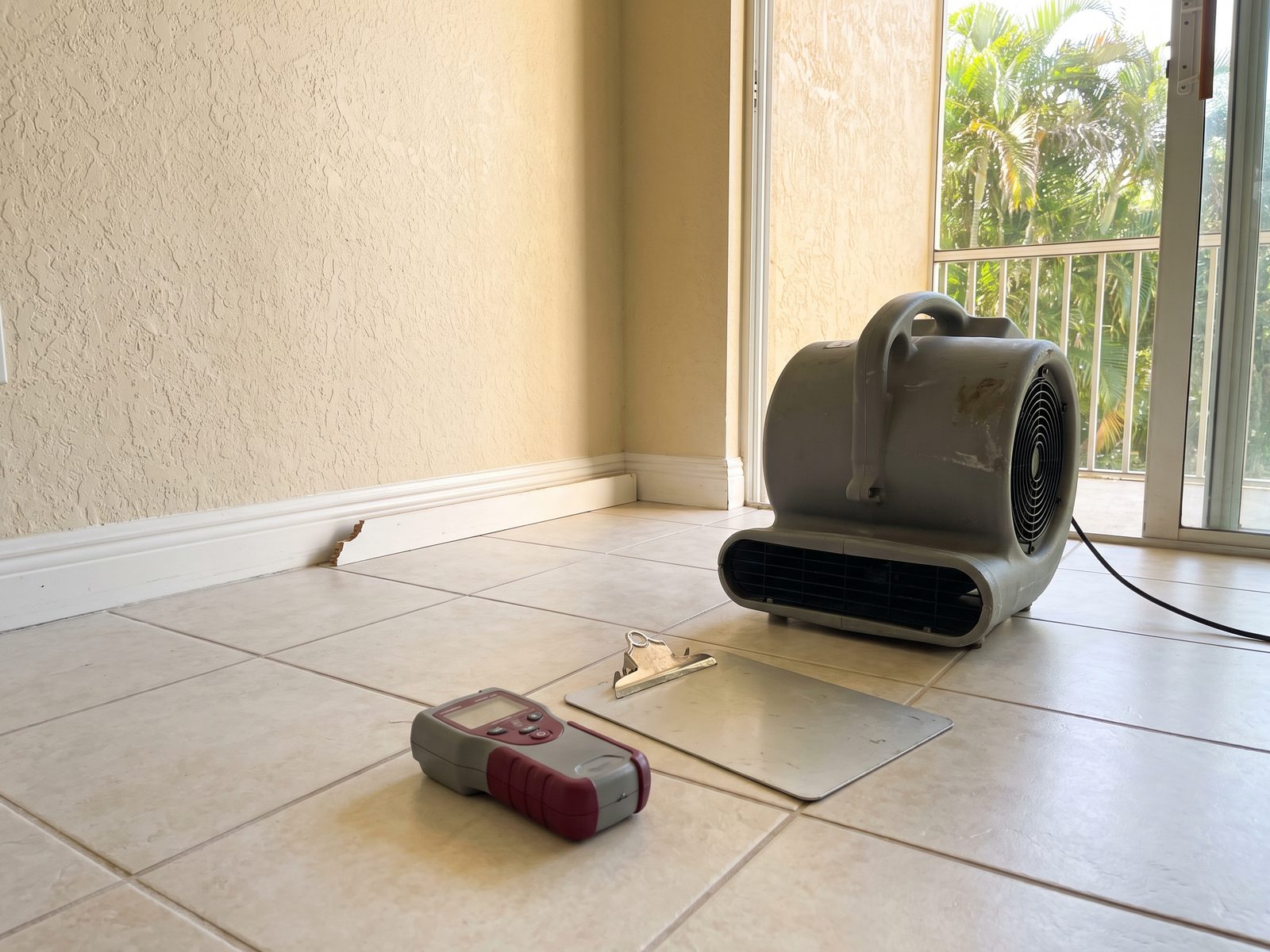
Because waiting costs the building. Wet gypsum, wet framing and wet insulation stay wet until something removes the water, and the longer they stay wet, the more of the structure ends up in a dumpster instead of being dried in place. In South Florida the ambient humidity works against you the whole time. A single-family house in Coral Gables and a unit in a Brickell high rise get there on different schedules, because a tower adds approved vendor lists, certificates of insurance, elevator reservations and restricted work hours before a hose reaches the floor. The clock is the same in both.
That is why the emergency phase is authorized separately from any rebuild. Mitigation is stopping the loss from growing: extraction, controlled demolition of unsalvageable material, containment, antimicrobial application, and air movers and dehumidifiers running until each affected area meets a documented drying goal under the ANSI/IICRC S500.
Reconstruction is a separate decision and a separate agreement. Signing an emergency authorization does not obligate you to use the same company to put the building back, unless the paper you signed says it does, and that is a clause worth reading for specifically.
Your claim runs on a third track again. The first payment on a Florida property claim commonly arrives weeks after the emergency work, and a mortgage servicer or a condominium association can add steps to how that money is released. None of it changes what the work cost or who requested it, which is the whole reason the payment term is written to the work rather than to the claim.
What documentation do you receive for your claim?
This is the part of the arrangement that earns its keep. Because you hold the agreement and you hold the claim, our job is to make your claim file as hard to argue with as possible and then hand it to you. Nothing is held back and nothing is sent anywhere first.
Florida requires part of this in any event. Section 489.147(2)(e) provides that a contractor may not give an insured an agreement authorizing repairs without also providing a good faith estimate of the itemized and detailed cost of services and materials for repairs undertaken pursuant to a property insurance claim. The same paragraph says a contractor does not violate it where the actual cost of repairs differs from the initial estimate as a result of the insurer's process of adjusting the claim.
The set below is what a reviewer needs in order to check a mitigation invoice without guessing. A reviewer who has to guess reduces the line.
- An itemized, detailed estimate and invoice, priced line by line against the scope of work actually performed
- Daily moisture readings for every affected area, with the temperature and humidity conditions they were taken in
- The drying record: what was wet on arrival, what the readings did each day, and the date each area hit its drying goal
- An equipment log showing what ran, where it ran, and for how many unit-days, a unit-day being one machine running for one day
- Time-stamped photographs of the affected materials, the work performed and the equipment in place
- Written answers to the adjuster's questions about the work performed, copied to you, so your file and ours never say different things
What if my carrier pays less than the invoice, or nothing at all?
You still owe the invoice. That is the hardest sentence in this post and it is the honest one. An agreement does not become smaller because a third party decided to pay less under a different agreement. What changes is how much of your own money you recover, and that is worth working at properly.
Start by asking your carrier, in writing, for the basis of the reduction or the denial. The answer usually sorts the problem into one of two piles: a question about whether the loss is covered, or a question about how much the covered work costs. The two arguments are made with different material.
The second pile is what your file was built for. Send the itemized estimate, the daily readings, the drying record and the photographs, and ask for a re-inspection where the disagreement is about quantities or drying days. Florida also runs state processes for a disputed residential property claim, and our post on mediation and appraisal walks through what each one is.
Where the disagreement is about coverage rather than cost, that is the point to consider a licensed public adjuster or an attorney. It is not our lane, and the next section explains why that is a legal boundary rather than modesty.
What can a Florida restoration contractor not do for your claim?
Florida draws that line in two statutes, and both are worth knowing before you let anyone tell you they will take the claim off your hands.
Section 626.854 defines a public adjuster as any person who, for money, commission, or any other thing of value, directly or indirectly prepares, completes, or files an insurance claim for an insured or third-party claimant. The definition adds that this holds regardless of how that person describes or presents his or her services, and it excepts a duly licensed attorney at law as exempted under section 626.860.
Section 489.147(2)(d) says it again inside the contractor's own chapter. A contractor may not interpret policy provisions, advise an insured regarding coverages or duties under the insured's property insurance policy, or adjust a property insurance claim on behalf of the insured. The paragraph carries one exception, which is that the contractor holds a license as a public adjuster under part VI of chapter 626.
So we do not negotiate your claim, we do not settle it, and we do not tell you what your policy covers, whether the loss is in Miami, Hollywood or anywhere else we work. We record what we found, what we did and why, we price it in itemized detail, and we answer an adjuster's questions about the work performed in writing, with a copy to you.
That is not false modesty and it is not a dodge. It is the reason the documentation has to be good. A contractor who cannot argue the claim has exactly one contribution to make to it, which is a record so complete and so plainly measured that the argument mostly does not need to happen.
What should make you stop and read before you sign?
The deductible is where the worst offers in this market live. If a contractor offers to waive it, absorb it, or make it disappear inside the invoice, stop reading the pitch and read the statute quoted above. An invoice engineered to make a deductible vanish is an invoice that no longer describes what the work cost, and the paperwork that reaches your carrier has your name on it.
The rest of the list is less dramatic and more common. None of these is proof of anything by itself, but any of them is a reason to slow down and ask for the answer in writing.
- A firm price for drying quoted before anybody has read a meter or mapped the moisture.
- No signed agreement, or a signed agreement you are never given a copy of.
- Any promise about what your carrier will pay, or how fast. No contractor knows that.
- A demand for the whole projected claim in cash before equipment arrives, which is a different thing from a deposit set at your deductible.
- A request that you endorse your carrier's payment over to the company before any work has been documented or invoiced.
- A clause appointing the company to negotiate or settle your claim, which Florida reserves for licensed public adjusters and attorneys.
- An automatic tie in requiring you to use the same company for reconstruction.
- An invoice with no readings behind it. If nobody can show you why a machine ran for another day, a reviewer will ask the same question later.
Where can I read the Florida rules myself?
Every statutory point above comes from a page you can open yourself. All three sections were fetched from the Florida Senate's statute site and read on September 21, 2026, and each sentence above claims no more than the text of the section supports.
What this post is not, one last time: it is not a statement about what your policy covers, and it is not legal or insurance advice. It is a plain description of how our own agreement and our own invoice work, so that the money part of a water loss holds no surprises at the end of it.
- Sources: Florida Statutes section 489.126, moneys received by contractors
- Florida Statutes section 489.147, prohibited property insurance practices and contract requirements
- Florida Statutes section 626.854, public adjuster defined, and the prohibitions that follow the definition
- ANSI/IICRC S500, the Standard for Professional Water Damage Restoration


