
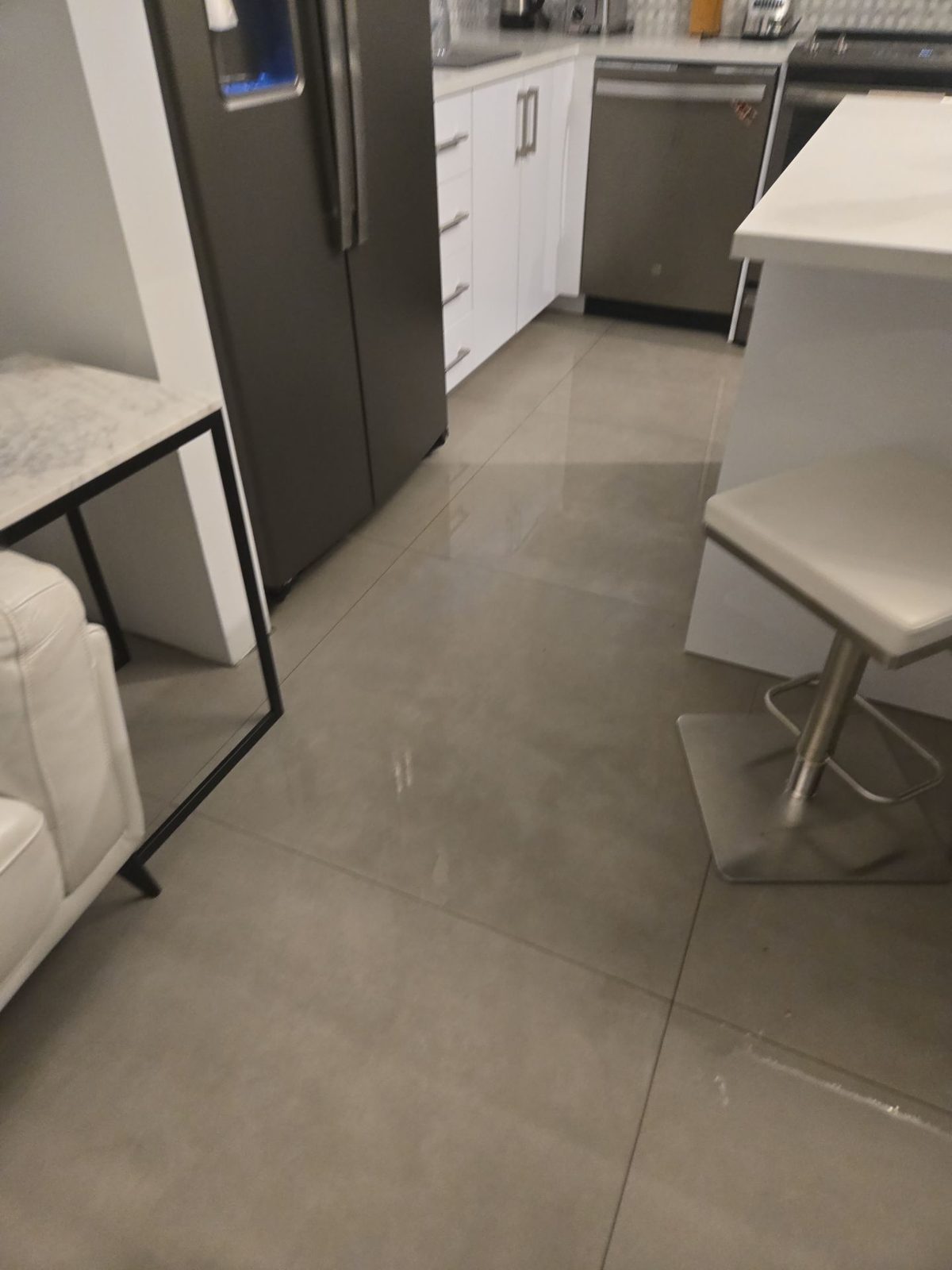
Water Damage Restoration in Brickell, Miami FL
Water damage restoration Brickell jobs are our home turf in the most literal sense: Restoration Doctor of South Florida's office is at 1200 Brickell Avenue, Suite 1950 #1007, inside the same condo canyon we serve. Brickell is the densest vertical neighborhood in Florida — tens of thousands of residents stacked in glass towers between Biscayne Bay and the Miami River — and water damage here follows the rules of the vertical city. A failed supply line on floor 41 is not a floor-41 problem; it is a problem for every unit in the stack below it. We answer those calls 24/7 at (786) 213-9489, often from a few blocks away.
The physics of a tower loss reward speed and mapping over everything else. Water released on an upper floor finds riser chases, slab penetrations, and electrical conduits, and moves down faster than it spreads sideways — so the units that need attention are frequently ones whose owners have not yet seen a drop. Our first hours on a Brickell loss go to stopping the source with building engineering, then tracing the true vertical footprint with moisture meters and thermal imaging before a single machine is placed.
At street level, Brickell has a different exposure entirely: it fronts Biscayne Bay on some of downtown Miami's most surge-vulnerable blocks, and hurricane storm surge has put seawater into Brickell's ground-floor lobbies, garages, and retail spaces in recent storms. We handle both faces of the neighborhood — the tower stack and the street level — under the same IICRC S500 documentation discipline.
How water damage behaves in Brickell
Unit-to-unit migration: the anatomy of a Brickell tower loss
When water releases in a Brickell high-rise, gravity writes the incident report. It drops through penetrations around plumbing and conduit, tracks along post-tensioned slabs to the nearest opening, and emerges from ceiling fixtures and wall bases in the units below. The visible damage in any one unit is a poor guide to the whole: we routinely find wet assemblies two or three floors below the lowest unit that reported a problem. That is why our Brickell protocol maps the entire stack — every potentially affected unit checked with instruments, one shared moisture map for the whole event, drying equipment placed where the readings demand it and nowhere else.
Documentation is the other half of the job. A multi-unit loss touches multiple owners' policies plus the association's master policy, and the boundary lines between them get drawn from evidence. Our per-unit photo records, moisture logs, and source documentation give every insurer involved the same factual record to work from.
Storm surge and street-level water on Biscayne Bay
Brickell's bayfront blocks are among the most storm-surge-exposed real estate in Miami, and recent hurricanes have sent seawater over the baywalk and into the neighborhood's streets, lobbies, garages, and ground-floor commercial spaces. Surge water is Category 3 and salt-laden: porous materials it touches generally must be removed, hard surfaces need rinse-down before drying, and elevator pits, garage levels, and mechanical rooms below grade need pumping and treatment before the building can safely restart its systems.
We work those street-level events with building management on the building's priorities — life-safety systems, elevators, and access first — while running the drying science underneath: extraction, contaminated-material removal, antimicrobial application, and monitored dehumidification to verified dry standards.
Working with your association and building management
In Brickell, nothing happens in a tower without the building's cooperation, and a mitigation contractor who cannot work smoothly with management slows everything down. We handle the logistics that tower work actually requires: certificates of insurance delivered to management before crews arrive, elevator reservations and equipment staging arranged, engineering looped in on shutoffs, and daily status updates that keep the association, the manager, and every affected owner reading from the same page.
Where drying reveals conditions beyond the water itself — pre-existing mold in a chase, for instance — we say so plainly and remediate under the IICRC S520 standard with containment and HEPA filtration, keeping common-element questions documented for the association rather than papering over them.
Brickell homes and how they fail
Brickell's residential stock is essentially all vertical: condo towers built in waves from the 1980s through the current boom, many exceeding 50 and 60 stories, plus a shrinking handful of older mid-rises. Inside those towers, the loss drivers are the pressurized systems every unit contains — washing-machine hoses, water-heater tanks and pans, refrigerator ice-maker lines, and the small angle-stop valves under every sink and toilet. On upper floors, municipal pressure boosted through the building's pumps means a failed valve can release a remarkable volume of water in the minutes before someone finds the shutoff. HVAC condensate systems are the other recurring culprit: in a climate where air conditioning runs essentially year-round, a clogged condensate line quietly overflows into ceilings and walls.
Newer Brickell towers finish units with engineered wood, stone, and level-5 drywall — materials that show water fast and cost real money to replace — while the 1980s-90s buildings carry aging original risers and valves reaching the end of their service life. In both generations, the mitigation has to run through the building as much as the unit: associations, management companies, and building engineers control access, shutoffs, and common elements, and we coordinate with all three as a matter of standard procedure, not as an afterthought.
Brickell neighborhoods we serve
Real Miami-Dade County communities — and the water losses we most often see in each.
The main canyon of condo towers — upper-floor supply-line and valve failures migrating down the stack are the defining loss.
Island towers reached by a single bridge, with bay exposure on all sides and logistics that reward a contractor who plans access in advance.
The newest wave of towers plus surviving older mid-rises; construction-era plumbing punch-list failures show up in young buildings here.
The blocks closest to Biscayne Bay, where hurricane storm surge reaches lobbies, garages, and ground-floor retail.
Mixed residential over street-level restaurants and retail, where a residential loss above can become a commercial loss below.
Full restoration services in Brickell
One operation covers every category — from emergency mitigation to full reconstruction.
Water Damage Restoration
Extraction, structural drying, and moisture verification for supply-line failures, drain-stack leaks, and unit-to-unit water migration in South Florida buildings.
Storm & Hurricane Damage Restoration
Emergency board-up, tarping, storm-water extraction, and post-hurricane structural drying for homes and buildings across Miami-Dade, Broward, and Palm Beach.
Mold Remediation
S520-based mold remediation: containment, HEPA-filtered removal, moisture-source correction, and post-remediation verification for South Florida homes and condos.
Sewage Cleanup
Category 3 water mitigation: sewage extraction, contaminated material removal, disinfection, and structural drying for backups and drain failures.
Fire & Smoke Damage Restoration
Structure securing, soot and smoke residue removal, odor treatment, and combined fire-and-water mitigation for South Florida properties.
Contents Restoration & Pack-Out
Full-chain contents handling: barcode-tracked inventory, pack-out, restoration cleaning, climate-controlled storage, and organized pack-back.
What Brickell homeowners look for
Brickell owners and property managers vet vendors carefully, and many are managing units from another city or country — so we keep our reputation where it can be verified, not just asserted. Our customer reviews live on a dedicated source-linked hub at restorationdoctorsreviews.com; read them there, then call the crew that officing on Brickell Avenue itself at (786) 213-9489.
Restoration Doctor of South Florida is part of the multi-state Restoration Doctor operation headquartered in Vienna, Virginia, bringing an established company's documentation standards to the vertical losses this neighborhood produces.
Frequently asked
Active water, mold, fire, or sewage event?
Connect directly with the Restoration Doctor team for your region. Crews are on standby 24/7 with documented response protocols.