What Does 'Dry' Actually Mean? Drying Goals and Dry Standards in Florida

BYSteve Jafari, General ManagerMIAMI-DADE, BROWARD & PALM BEACH
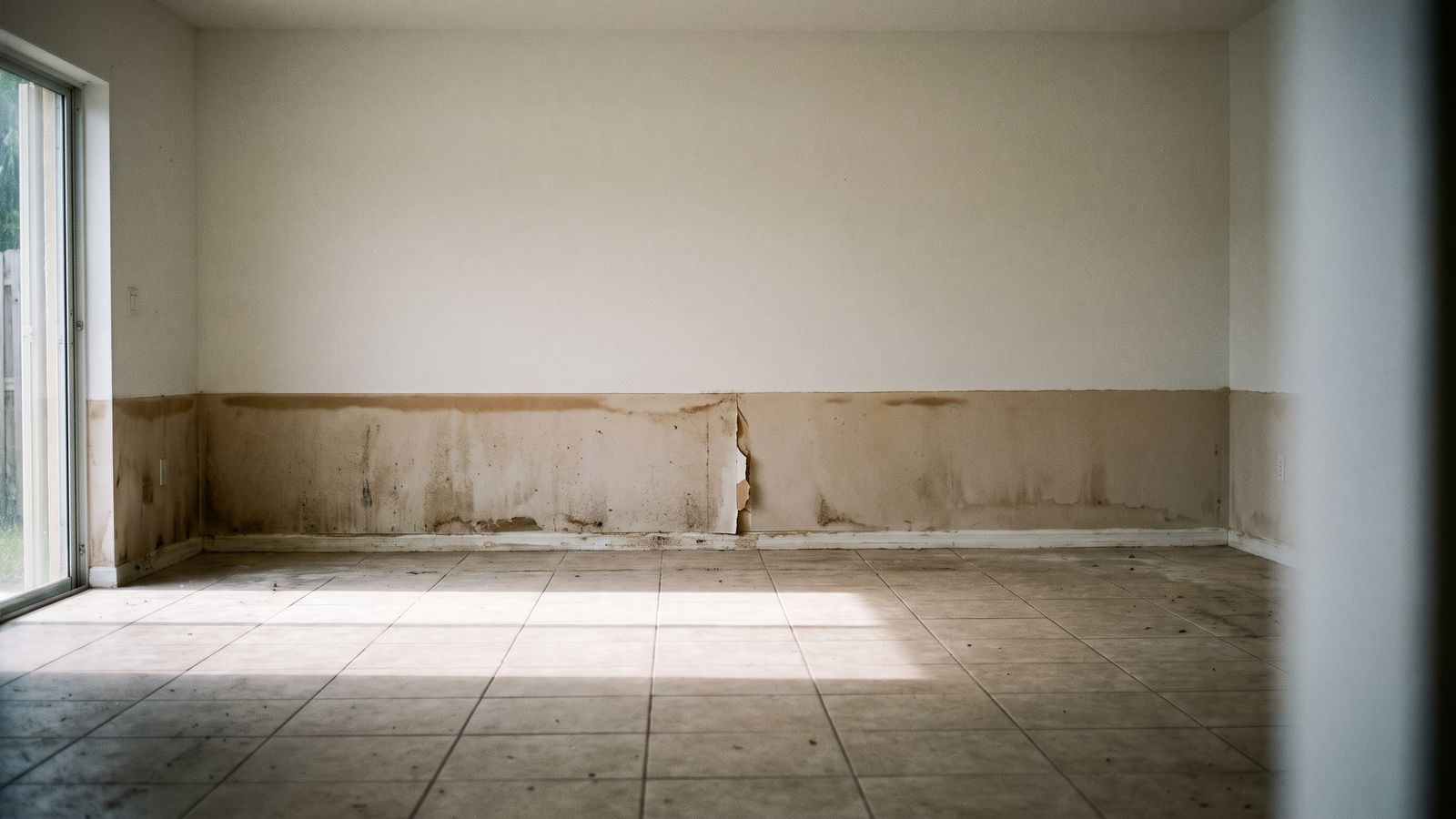
A drying goal is a measured number taken from unaffected material in the same building, not a calendar date, and drying is complete when the wet materials reach it. In South Florida that number sits higher than in drier climates, which is why a crew drying to an imported standard runs equipment longer than the building needed.
Call (786) 213-9489What does 'dry' mean on a water damage job?
Dry means the materials the water reached read the same as the materials it never touched. That is the whole definition, and every drying goal on a water damage job sits underneath it. A crew measures untouched material in the same building on day one, writes that number down, and the number becomes the finish line for the job.
What dry does not mean is worth saying plainly. It does not mean the floor feels dry to a hand. It does not mean the fans have been running for some set number of days. Surfaces go dry to the touch long before the material behind them lets go of its water, and in South Florida that gap is wider than most homeowners expect.
The distinction costs money in both directions. Stop short of the number and moisture stays inside the wall, feeding growth behind paint that still looks perfect. Run past the number and you pay for equipment days the building never needed. Both errors come from the same habit, which is treating dry as a judgment call instead of a measurement.
- Dry is a measured comparison, not a surface feel or a fixed number of days.
- The comparison material is unaffected material inside the same building.
- The reading is taken on day one, before drying equipment changes anything.
- Drying ends when affected materials meet that reading, room by room and material by material.
What is a drying goal, and who sets it?
A drying goal is the target moisture level a crew commits to reaching in each affected material. The restorer sets it, usually on the first visit, and it belongs in the job file before a single air mover goes down. It is not handed over by the carrier and it is not a company preference. It comes off a meter in your building, on the day work starts.
In practice the technician walks the parts of the house the water never reached and takes readings on the same materials that got wet. Drywall against drywall, plank against plank, block wall against block wall. Those readings describe what normal looks like in that structure, with that air conditioning system, in that week of weather. The goal is then set at or slightly below normal.
Job-site vocabulary gets used loosely, so here are the terms laid out cleanly. A homeowner who knows the difference can read a monitoring log without help.
| Term | What it is | Who or what sets it | What it is not |
|---|---|---|---|
| Dry standard | The moisture reading that unaffected material of the same type gives in the same building | Measured on site, before drying starts | A national average or a figure copied out of a manual |
| Drying goal | The target the crew commits to reaching in each wet material, set at or below the dry standard | The restorer, recorded in the job file on day one | A promise about how many days the job will run |
| Equilibrium moisture content | The level a material settles at when it stops exchanging water with the air around it | Temperature and relative humidity of the surrounding air | A fixed property of the material itself |
| Reference material | The specific untouched piece used to take the dry standard reading | Chosen by the technician, same material and same construction | Any dry-looking spot picked at random |
| Dry to the touch | A surface condition that says nothing about what sits behind it | Evaporation at the face of the material | Evidence that drying is finished |
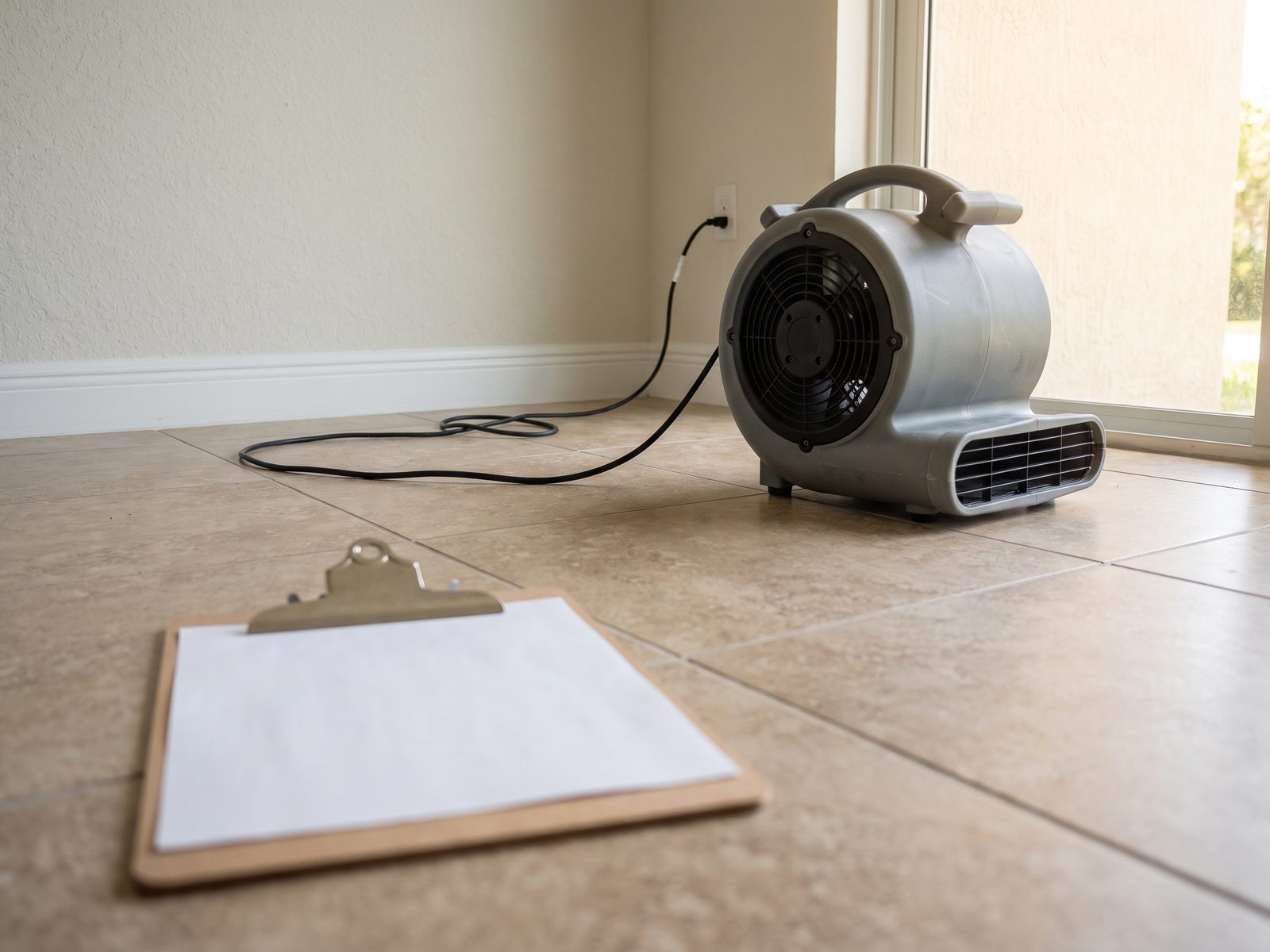
What is a dry standard, and where does the number come from?
The dry standard is the reading itself. If an untouched interior wall in your home gives a certain value on a pin meter, that value governs every wall of the same type on the job. The number belongs to the building, which is the entire point. Two houses on one street can carry different dry standards because one runs its air conditioning constantly and the other sits closed up between visits.
Good practice here comes from the water damage restoration standard published by the IICRC, known as S500, which describes establishing a drying goal from unaffected materials and documenting progress toward it. It is a consensus industry standard, not a law, and no inspector enforces it. It is what a competent restorer works to and what a claim reviewer expects to see in the file. Our sister company at restorationdoctors.com covers the S500 standard behind these numbers.
Sometimes no unaffected reference exists, which happens in a small condo unit where the loss touched every room of the same type. The restorer then falls back on published guidance for that material and says so in writing. If nobody can tell you where the target came from, the target is decoration.
Why is the Florida dry standard higher than a northern one?
Because the reference material is in equilibrium with the air around it, and the air here is loaded. Outdoor air across Miami-Dade, Broward and Palm Beach runs humid for most of the year, with mornings wetter than afternoons. Wood, paper facing and gypsum take on moisture from humid air until they stop gaining. That settled level is what an untouched board reads, and it is the level a crew dries back toward.
A crew working from a number learned in a cold, dry market brings a lower target with them. Applied to a South Florida house, that target sits below what the building's own untouched materials read. Dehumidifiers keep running and the structure gets pushed drier than it will stay. Within days of the last fan leaving, the material drifts back up to where the air holds it.
Construction adds to the effect. Much of the region is concrete block with stucco outside and furring strips with drywall inside, all on a slab. Block and slab hold water differently from stick framing and give it back slowly. A dry standard taken off that block tells the crew what the wall genuinely returns to.
- The reference number reflects the building's own conditions, not a regional average.
- Block walls and slab floors release moisture slowly, so readings fall in steps rather than smoothly.
- An imported target pushes materials below where they will settle once the equipment leaves.
- A running air conditioning system lowers the standard; a closed, unconditioned unit raises it.
What is equilibrium moisture content?
Equilibrium moisture content is the level a material settles at when it is neither gaining nor losing water to the air touching it. Put a dry board in humid air and it gains weight. Put a wet board in dry air and it loses weight. Leave either one alone long enough and it stops changing. That resting point is the equilibrium moisture content for those conditions.
The conditions are the moving part. Raise the relative humidity and the resting point rises with it. Change the temperature and the same air holds a different amount of water, which shifts the resting point again. That is why a dry standard has a shelf life. A reading taken during a dry stretch in a conditioned house is not the reading you would get during a week of afternoon storms with the power out.
For a homeowner the takeaway is short. Materials in a Florida house are never bone dry and are not supposed to be. Drying a loss means returning them to the working level the surrounding air keeps topping up, not driving them toward zero.
Which readings justify pulling the equipment out?
One reading on one wall does not end a job. The set of numbers that ends a job covers every affected material, in every affected room, across consecutive days, with the ambient conditions recorded beside them. A restorer should be able to show you all of it before the truck loads up.
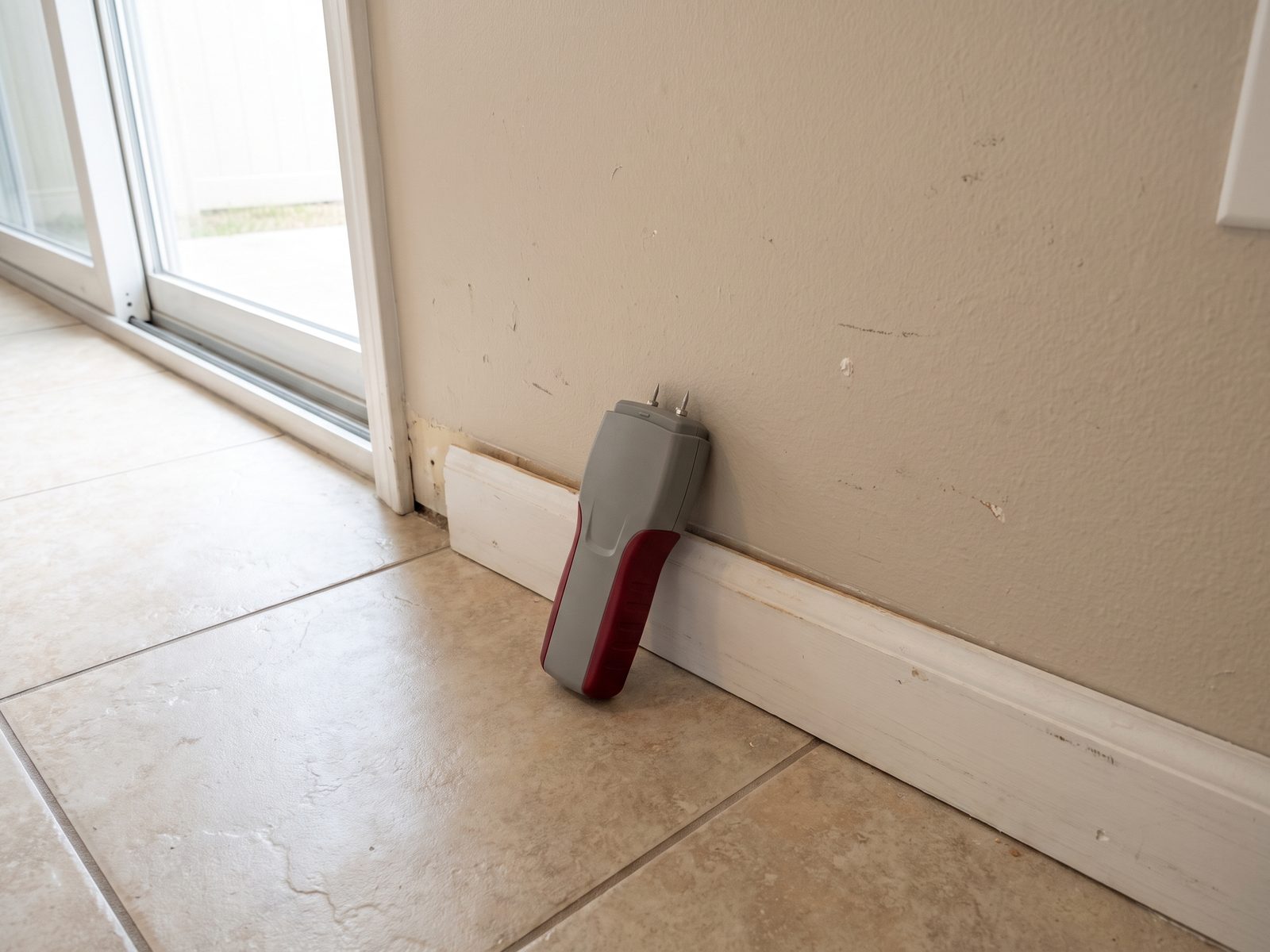
Penetrating meters with pins go into the material and give a moisture content value that compares directly against the dry standard. Non-penetrating meters scan without leaving holes and give relative readings useful for mapping how far moisture traveled. Thermo-hygrometers record temperature and relative humidity inside the affected space, outside the building and at the dehumidifier outlet. A thermal camera finds cool spots worth checking but proves nothing alone.
If one bedroom hits the goal on day two while the hallway is still climbing, the equipment in the hallway stays. Pulling everything the moment the first room finishes is the shortcut that produces a call back weeks later about a smell nobody can place.
- Every affected material reads at or below its own dry standard, not only the easy ones.
- The readings hold across two consecutive monitoring visits rather than dipping once.
- Readings come from the same marked locations each day so the numbers actually compare.
- Hidden assemblies are checked directly, including wall cavities, cabinet bases and the layers under flooring.
What happens if a crew dries to the wrong number?
There are two ways to be wrong and they fail in opposite directions. Stopping above the dry standard leaves moisture inside the assembly. In a warm, humid house that is an open invitation, and EPA guidance says wet materials dried within 24 to 48 hours will in most cases not grow mold. The result surfaces later as a stain, a musty smell, or a floorboard that will not stop cupping.
Drying well past the number fails differently. Equipment days accumulate and each one is a line on the invoice. Over-drying can also shrink and check solid wood, loosen glued assemblies and split trim that was fine before the fans arrived. The material was heading back toward its equilibrium anyway, so the extra days buy nothing permanent.
There is a claim angle as well. A file showing drying stopped short invites the argument that later deterioration was avoidable. A file showing equipment ran for days after the goal was met invites the opposite argument. A documented goal, met and proved, closes both doors.
How is all this recorded on the daily monitoring log?
The monitoring log is where the goal turns from a claim into a record. It opens with the initial readings, including the dry standard and the material it came from, then carries a dated line for every visit. Each line lists the same marked reading points, the values they gave, the ambient conditions and the equipment running in that room.
Read down a column and a trend should appear. Moisture content falling day over day says the plan is working. A flat line across two days says something is wrong: not enough dehumidification, a material that needs opening up, or an air mover aimed at a wall that was never the wet one. A good restorer changes the plan when the log says to.
Ask for the log in whatever form the company keeps it, paper or digital, and ask during the job rather than after it. Our sister company walks through reading the daily drying log line by line, and the layout is the same wherever the job sits. What changes here is the target printed at the top of the page.
- Initial readings, including the dry standard and which material produced it.
- A dated entry for every monitoring visit, taken at the same marked points each time.
- Temperature and relative humidity for the affected space and for outside air.
- Equipment placed, moved or removed, with the day each change happened.
- Any material that came out instead of drying, with the reason recorded.
- A final entry showing every affected material at or below goal.
What should I ask to see before signing off on drying?
Five questions separate a finished job from a finished truck schedule. Ask them before you sign a completion form, because that signature is what the paperwork treats as your agreement that the structure is dry.
None of the five below are confrontational, and a crew that documents properly answers every one of them from the tablet in their hand. Hesitation is the signal. If the answer is that the job feels dry, the readings are not there to show you.
Our crews set a dry standard on the first visit, record it in the job file, and monitor to it daily until every affected material meets it. We bill you, the homeowner, and hand you a carrier-ready claim file with the readings inside it. If a wall is still wet on the last scheduled day, we say so rather than loading the truck.
- What is the dry standard for this job, and which unaffected material did you read to get it?
- Which materials are still above goal today, and what is the plan for them?
- Can I see the monitoring log, including today's readings?
- Were wall cavities, subfloor and cabinet bases checked directly, or only the surfaces?
- What does the final reading sheet show for each affected room?
Where can I read the standards for myself?
The standards and public health guidance behind drying goals are published and free to read. These are the ones worth your time.
- IICRC standards, including S500 for water damage restoration and S520 for mold remediation.
- EPA, a brief guide to mold and moisture.
- CDC, mold and your health.