Commercial Restoration in South Florida
Large-loss mitigation and reconstruction for high-rise condos, hotels, retail, offices, and managed properties — dedicated dispatch, business-continuity scheduling, and insurance-grade documentation across Miami-Dade, Broward, and Palm Beach.
What counts as a commercial restoration loss in South Florida?
Commercial restoration covers property damage to any building that runs a business or houses tenants — office suites, retail storefronts, restaurants, medical and dental practices, hotels and resorts, houses of worship, schools, and the multifamily and condo buildings a property manager or association oversees. The damage types are the same physics as a home loss — water, storm, fire and smoke, mold, and sewage — but the scale, the schedule pressure, and the number of stakeholders are entirely different. A burst riser on the twentieth floor of a Brickell tower does not stay on the twentieth floor; it cascades down through units, elevator shafts, and electrical rooms, and every hour it sits is an hour of lost rent, closed operations, and mounting exposure.
In South Florida the environment raises the stakes further. Year-round humidity means a commercial water loss starts trending toward mold within 24 to 48 hours, hurricane season brings wind-driven-rain and roof-intrusion events that hit entire buildings at once, and high-rise construction spreads water across multiple floors and shared assemblies. That is why commercial work here is its own discipline rather than a bigger version of a residential project — the equipment footprint is larger, the logistics involve elevators and loading-dock scheduling and association rules, and the documentation stakes are higher because a commercial claim often involves a property carrier, a tenant's policy, a business-interruption component, and a management company that all need the same clean, defensible file.
How fast can you mobilize for a commercial emergency?
Speed is the single biggest lever on the size of a commercial loss, so our commercial dispatch runs 24 hours a day, every day of the year, with intake that skips the general queue. For a commercial building, the difference between a one-hour and a four-hour response can be the difference between drying a corridor and gutting a floor — and in our climate, between stopping a water loss and starting a mold project.
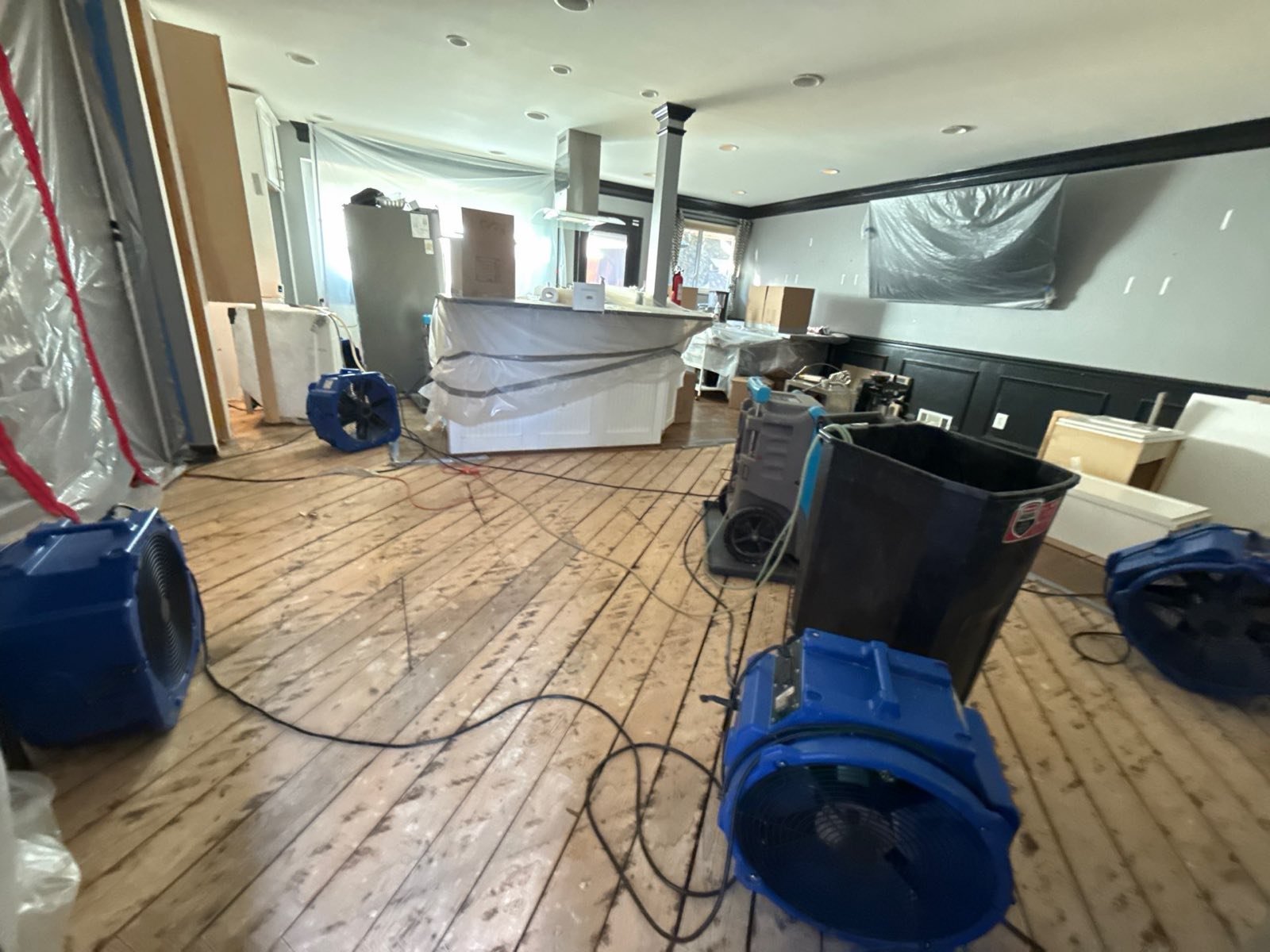
On the first mobilization we do three things at once: stop or isolate the source, extract standing water and stabilize the structure, and scope the loss with moisture mapping and thermal imaging so the drying plan is built on data instead of guesswork. For a large or multi-floor high-rise loss we scale equipment and manpower quickly — staging additional air movers, high-capacity dehumidifiers, generators, and negative-air machines as the moisture map dictates — rather than making a building wait days for a second truck.
How do you keep my business running during restoration?
For an operating business or an occupied building, closing entirely is often the most expensive outcome of a loss — sometimes more expensive than the damage itself. Our commercial approach is built around business continuity: containment barriers and negative-air machines isolate the affected area so the rest of the building stays open, and phased overnight and weekend work keeps drying and reconstruction moving without shutting down the operation during business hours.
In a high-rise or hotel that means coordinating with management on elevator use, work hours, guest and resident impact, and access, so the disruption stays contained to the affected units and corridors. The goal is always the same: dry and rebuild the damaged space to standard while the parts of the building that can keep working, keep working.
Property managers, condos & HOAs: multi-unit and common-area losses
In a condo or multifamily building, a single loss frequently touches multiple units and common elements at once, and the parties — owners, tenants, the association, and several carriers — need documentation that clearly separates what happened where. We provide a single point of contact, per-unit and common-area scope breakdowns, and a documentation package a property manager or board can forward to residents, owners, and insurers without rewriting it.
Because water in a high-rise travels through shared assemblies, we dry and document across all affected units rather than treating each in isolation — which is how hidden moisture in a shared wall or slab is found before it becomes a mold discovery weeks later. Clear records of the source, the timeline, and the scope protect every party and keep a multi-stakeholder claim from stalling.
What is a Master Service Agreement, and why set one up before a loss?
A Master Service Agreement (MSA) puts pre-negotiated terms, priority response, and a per-building emergency plan on file before anything goes wrong. When a loss happens, an MSA turns an emergency into a priority call with a plan already in place — we know your building, your access requirements, your key contacts, and your documentation preferences — instead of a cold vendor search during a crisis.
For South Florida property managers, the most valuable time to establish an MSA is before hurricane season, when a single storm can generate losses across an entire portfolio at once. Having a restoration partner already contracted and briefed on each building is the difference between being first in line for crews and equipment and waiting behind everyone else who is calling for the first time after the storm.
Documentation and insurance for commercial claims
Commercial claims are documentation-intensive, and getting the file right is often what determines how fully and quickly a claim settles. Every project is documented in CompanyCam with time-stamped photos from arrival through verified dry-out, alongside moisture readings, thermal images, and a line-item scope — the insurance-grade record a property carrier, a tenant's policy, and a business-interruption adjuster all need.
Our billing model protects the property owner: we bill you, the owner or management company, and hand you a carrier-ready claim file you submit — we do not bill your insurance company directly, and you should be cautious of any contractor who says the carrier is their customer. That structure keeps us working for you, not the insurance company, which matters most when a large commercial claim gets contested.
Built for commercial scale
What a property manager or facility director is actually buying when they call a company built for commercial and high-rise losses.
A 24/7 commercial intake that skips the general queue — because when your building is flooding, minutes decide whether you dry a corridor or gut a floor.
Truck-mounted extraction, high-capacity dehumidification, generators, and the crew count to dry across multiple floors and shared assemblies instead of one unit at a time.
Containment, negative air, and phased overnight and weekend work that keeps the operating parts of your building open while the affected areas are dried and rebuilt.
Pre-negotiated terms, priority response, and a per-building emergency plan on file — set up before hurricane season so a storm is a priority call, not a cold vendor search.
A single point of contact, per-unit and common-area scope breakdowns, and documentation a property manager or board can forward to residents and owners without rewriting it.
CompanyCam photo logs, moisture readings, and a line-item scope handed over as a carrier-ready claim file — we bill you, not the insurance company.
Frequently asked
Active water, mold, fire, or sewage event?
Connect directly with the Restoration Doctor team for your region. Crews are on standby 24/7 with documented response protocols.