
Matching Mid-Century Terrazzo and Florida's Matching Statute

BYSteve Jafari, General ManagerMIAMI-DADE & BROWARD
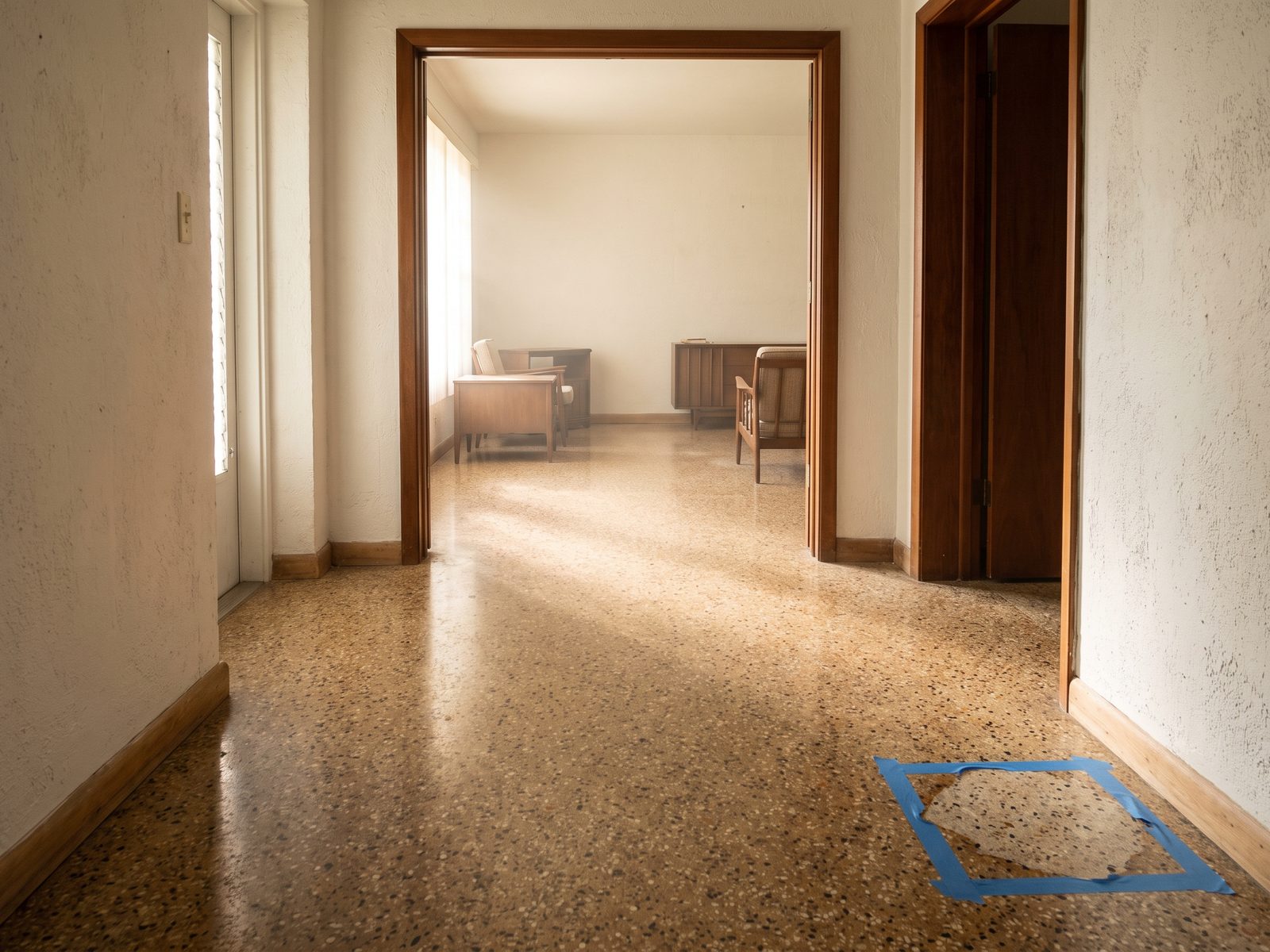
Section 626.9744 of the Florida Statutes addresses items that do not match in quality, color or size after a loss. How it applies to a loss depends on your policy and your insurer's decision. Questions about coverage belong with your insurer, your agent, or a licensed public adjuster or an attorney.
Call (786) 213-9489What does Florida's matching statute actually require?
Florida Statutes section 626.9744 is titled claim settlement practices for homeowner's insurance. It contains language about replaced items that do not match in quality, color or size in adjoining areas. The statute text is public, and the section is linked at the end of this article.
Whether and how that section applies to a particular loss is a coverage question. Coverage depends on your policy and your insurer's decision. Questions about coverage belong with your insurer, your agent, or a licensed public adjuster or an attorney.
What counts as an adjoining area, and where does line of sight come from?
The statute uses the words adjoining areas. Line of sight and contiguous area are claims industry phrases. Whether two rooms are one adjoining area is a question for your insurer, or for a licensed public adjuster or an attorney.
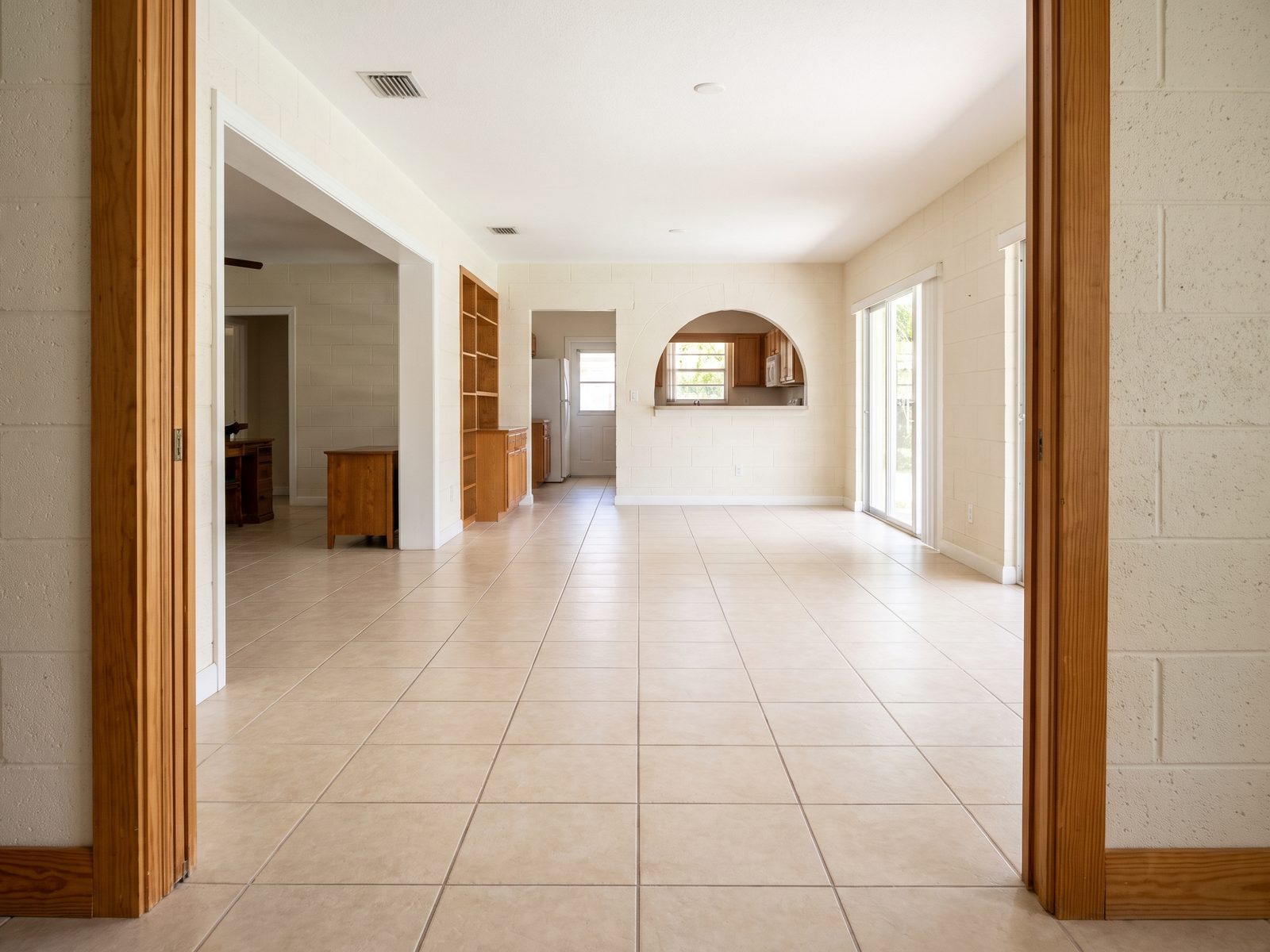
In the field, a floor that runs unbroken from the kitchen through the dining room and down the hall is one visual plane, and a photograph can show that. A floor that stops at a threshold strip, a change in level, or a closed door looks different in the same photograph.
Why does continuous tile on a Florida slab raise this so often?
South Florida builds floors differently from most of the country. Homes sit on slab, so a tile or terrazzo field can run from the front door to the back porch without a single level change or subfloor break. A single wet room is very often one continuous surface shared with three or four other rooms.
Poured terrazzo is hard to match physically. The color came from the pigment and the aggregate in a batch that was mixed on that site on that day, by a crew working to a local supplier's stone. A skilled terrazzo contractor can grind and polish a patch to a close tone, and on a small repair that is often the right answer. Over a large area the aggregate density and the seam still read as a repair from across the room, in daylight.
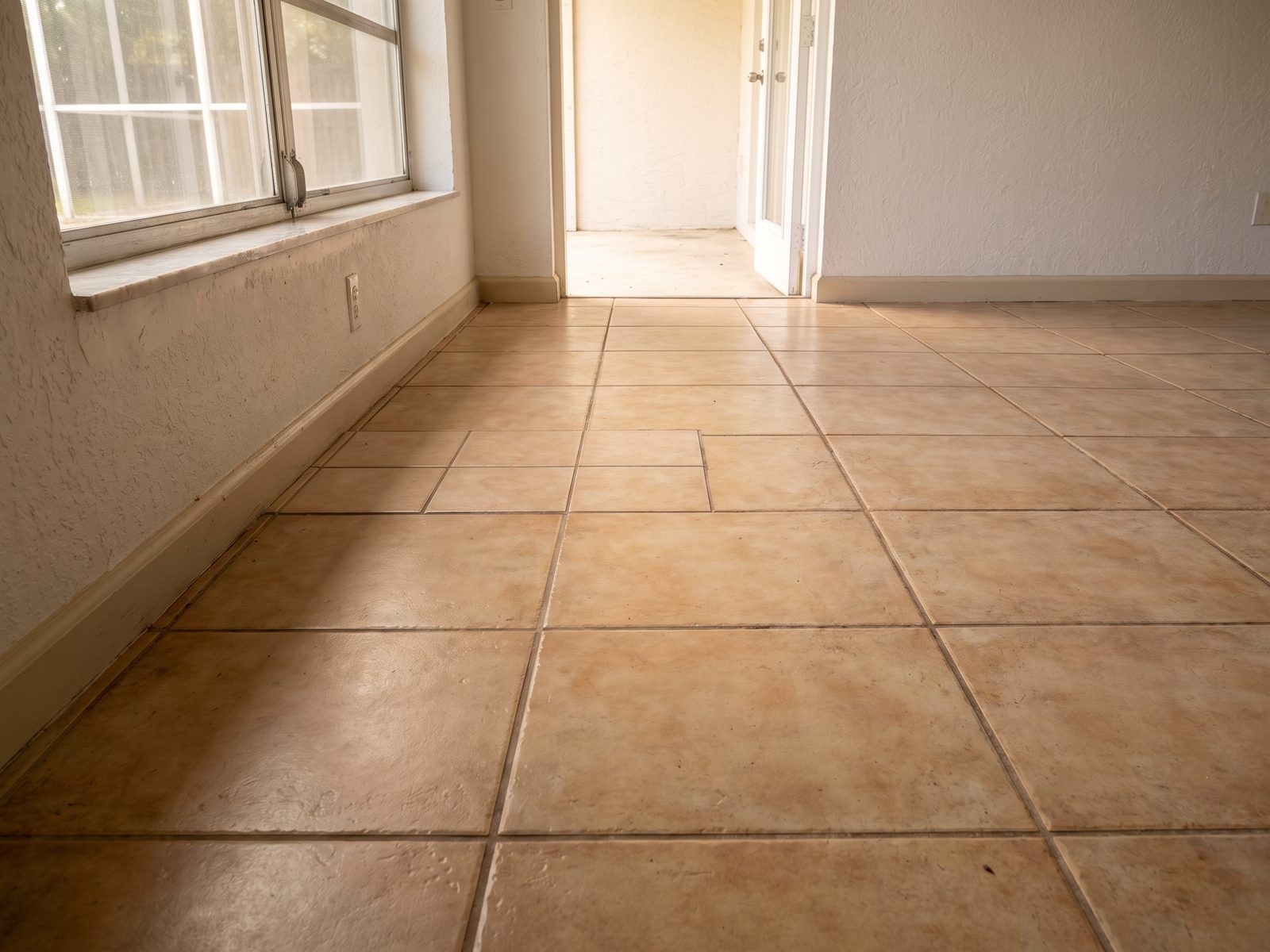
Tile differs. Even a product still in production shifts between dye lots, and manufacturers rate how much shade variation a run can carry. Older mosaic, quarry tile and cement tile of the Cuban type are the hardest tile cases. Thin set laid straight onto slab adds a second problem: removing wet tile from one room routinely chips or cracks the first course inside the next room. We photograph that collateral breakage as it happens.
How is a tile, terrazzo or cabinet finish identified?
Whether a product is still available, and whether a match is required, are questions for your insurer. Coverage depends on your policy and your insurer's decision. Questions about coverage belong with your insurer, your agent, or a licensed public adjuster or an attorney.
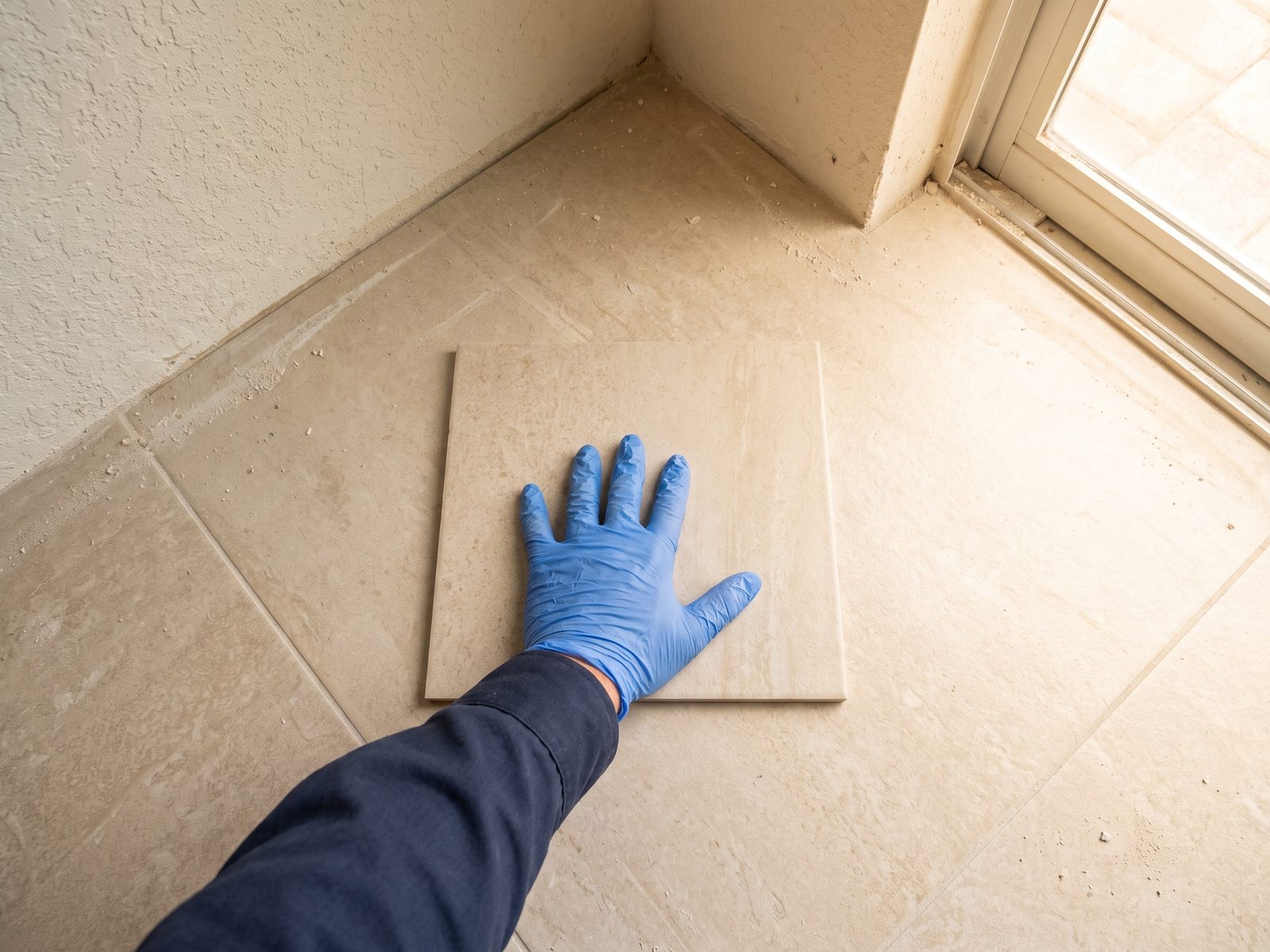
Product identification starts with a physical sample. Many tiles carry a manufacturer stamp, a series name, a size code and sometimes a run date on the back. Terrazzo carries nothing, so identification there is a physical sample plus dated photographs of the surrounding field.
- Keep one intact sample unit in a bag, labeled with the room it came from and the date you lifted it.
- Photograph the back of the sample so any manufacturer mark, series code or size stamp is legible.
- Measure the unit yourself, because nominal sizes changed across decades: face dimensions, thickness, edge profile.
- For cabinets and trim, identify the door profile and finish rather than the brand, because a door style can be dropped while the line continues.
What photographs help document a flooring loss?
Photographs taken before mitigation begins record the condition and layout of the floor. We provide our photos, moisture readings and invoice to you and, at your request, your insurer.
Shoot before mitigation changes the room. Once baseboard is off and equipment is running, the sight line frame is gone for good.
- A wide frame from each doorway at standing eye height, showing the floor running from the wet area into the next room without a break.
- A low frame down the floor plane, close to the surface, where a shade shift or pattern change shows most clearly.
- A close frame of the damaged area with a tape measure in the shot, so the repair footprint is a number and not an impression.
- A frame of every transition, or of the spot where a transition would be if one existed, showing whether the run is uninterrupted.
- The same rooms in natural daylight and again under the fixtures the household actually uses after dark.
- A floor plan sketch marking the continuous field, so the sight lines have a map to sit on.
Does matching apply to mitigation work or only to repairs?
Two different jobs get confused here. Mitigation is the emergency work: extraction, containment, controlled removal of unsalvageable material, and structural drying to a verified standard. Repair is what puts the property back, and it is a separate phase from mitigation. Matching is a repair-phase topic and does not decide how a wet floor gets dried.
Mitigation decisions still affect what material remains afterward, so we record what is removed and why.
The drying standard the trade works to is the IICRC S500 for professional water damage restoration, and it drives remove or dry in place from moisture readings and material condition, not from appearance. On slab that distinction is practical: tile bonded to concrete can often be dried in place with the right equipment, while the same water under a floating floor is usually a removal. Keep those calls separate from the appearance conversation.
Where do questions about matching go?
Whether matching applies to a loss turns on the age and condition of the floor and the product. Coverage depends on your policy and your insurer's decision. Questions about coverage belong with your insurer, your agent, or a licensed public adjuster or an attorney.
What happens when the association owns the flooring standard?
Association documents complicate this in a specific way. The declaration defines what counts as unit property and what belongs to the association. Many South Florida buildings then add a floor covering rule: an approved underlayment, a sound rating for hard surfaces above the ground floor, or a short list of permitted materials. If the original floor predates that rule, matching it may no longer be allowed at all.
Read the declaration and the current rules before any meeting, and ask the association to state its flooring requirement in writing.
Which insurance policy responds to which part of a loss is a coverage question. Coverage depends on your policy and your insurer's decision. Questions about coverage belong with your insurer, your agent, or a licensed public adjuster or an attorney.
Who can help if an insurer declines a request?
Questions about an insurer's decision belong with your insurer, or with a licensed public adjuster or an attorney.
Restoration Doctor does not adjust claims, give legal advice, interpret your policy, negotiate with your insurer, or represent you in your claim. We provide our photos, moisture readings and invoice to you and, at your request, your insurer.
The underlying rules are public, and they are short enough to read in full. Sources:


