
Structural Drying & Dehumidification in South Florida
Restoration Doctor of South Florida dries the building itself after a water loss across Miami-Dade and Broward: tile over concrete slab, block and stucco walls, furring and drywall, read every day until the materials reach their dry standard. Call 786-213-9489, 24 hours a day.
What structural drying is, and what comes before it
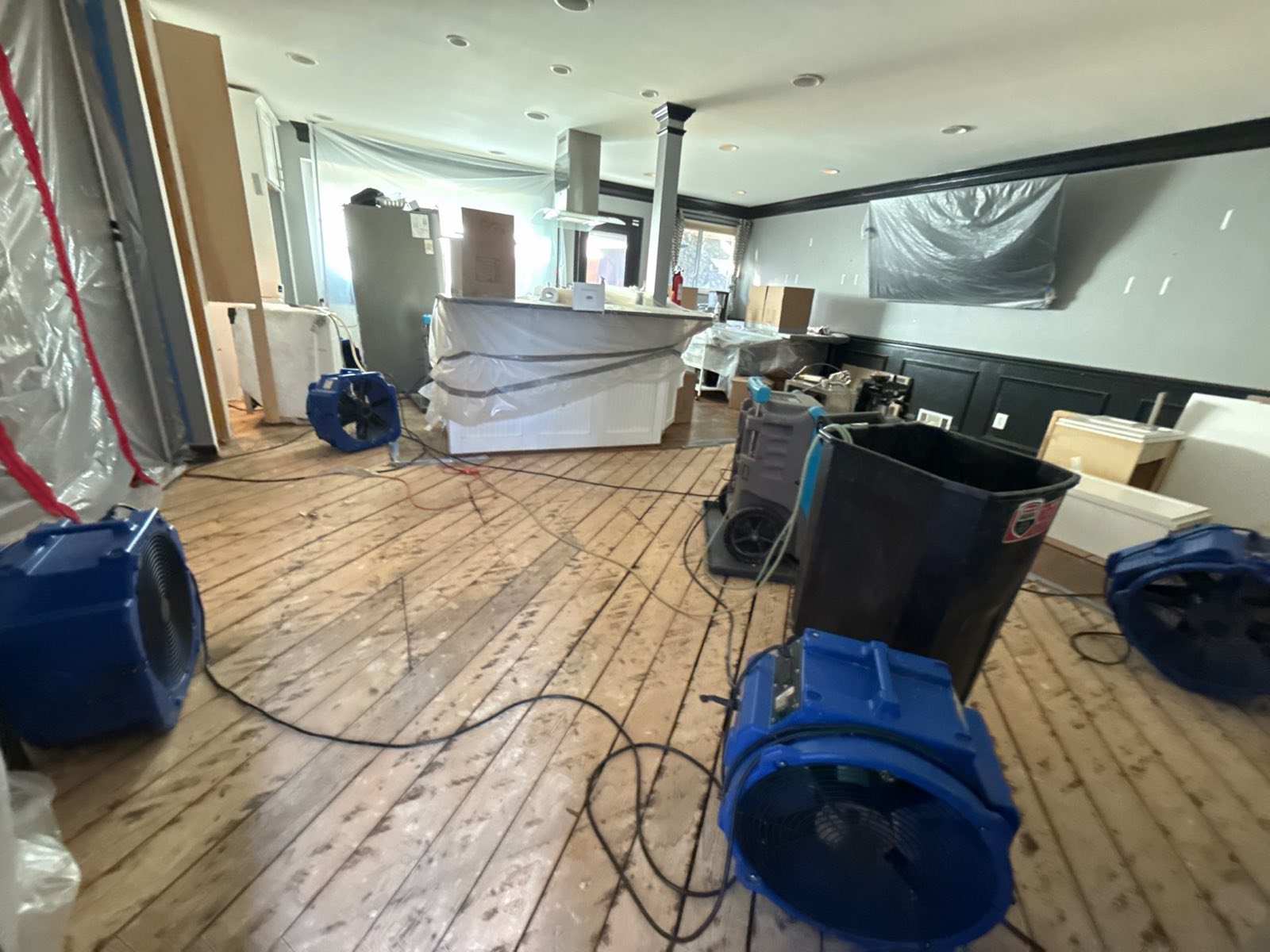
Restoration Doctor of South Florida is a water mitigation company. Structural drying is the part of a water loss that starts after the standing water is extracted: the building's own materials, meaning the concrete slab, the block walls, the wood or metal furring, the drywall and the finish floors, still hold water, and they are dried with air movement and dehumidification until they verify dry.
In South Florida the drying is done in a closed, mechanically dehumidified space. Outdoor air here carries enough moisture to slow the job, so opening windows does not dry a wet building. Air movers release moisture from the surfaces, and dehumidifiers remove it from the air. Which dehumidifier suits a given job is a decision about containment and conditions, and our guide to LGR and desiccant dehumidifiers explains it.
The sequence is extraction, a moisture map of the wet footprint made with meters and thermal imaging, a drying setup sized to that footprint, and readings every day. The equipment stays until the materials reach the dry standard, not for a fixed number of days.
Tile over a concrete slab
A large share of South Florida floors are tile over slab. Water on tile does not soak down the way it would into a wood subfloor. It travels sideways under the tile, wicks up the bottom of the drywall and sits in the thin-set and the pores of the slab, where a mop never reaches. A floor can look dry on top while the layers beneath are still wet.
That is why the first work after extraction is mapping, not guessing. Thermal imaging along cabinet toe-kicks and wall bases shows where moisture went, and meters confirm it. Drying is aimed at the mapped area, and the same spots are read again the next day so each number can be compared with the last.
Concrete block and stucco walls
Most exterior walls here are concrete block and stucco, with furring strips, sometimes foam board, and drywall on the inside. Each layer holds water differently. The block takes water into its cells and mortar joints and gives it up slowly. The narrow cavity behind the drywall holds still air that a room fan never reaches. Water runs to the base of the wall, so a wall can read normal at chest height and wet at the baseboard.
For that reason readings are taken in a grid, at the baseboard, a foot up, three feet up and at the ceiling line when the water came from above, and each carries a location so tomorrow's number lands on the same spot. Where the cavity can be reached, small holes behind the baseboard let air move through it so the assembly dries in place. Drywall comes out when the cavity cannot be dried, when insulation is saturated, or when the water was contaminated.
How drying is monitored, and when it ends
The drying goal is a measured number taken from unaffected material in the same building, not a calendar date. Moisture readings, temperature and humidity are logged every day against the recorded baseline, with equipment placement noted, so the file shows what was wet, what was done and when each material reached the goal.
A room is called dry when every wet material in it has reached that goal. A surface reading alone does not close out a room, because block, furring, foam board and drywall dry on different curves. Equipment is removed after the final readings verify the goal.
What this page does not cover: repair
We dry and document. We do not repair or rebuild. Where drying leaves finishes that need replacing, such as flooring, drywall, paint or trim, we can refer you to licensed contractors. The moisture and photo record we hand over shows the condition the repair starts from.
Water that crossed a yard or street, and water from a drain, is treated as contaminated and handled under the contaminated-water protocols described on our water damage and sewage pages, not simply fanned dry.
What drives the cost of a drying job
The size of the wet footprint, the materials involved, how many layers of the wall are wet, how many days the readings take to reach the goal and how many pieces of equipment the setup needs all move the total. Equipment is billed per unit per day, so delay in starting adds days. A single-room dry-out and a multi-unit loss sit in different ranges, and a flat price quoted over the phone is a guess. What we provide is a written line-item scope, with the photos and moisture readings behind each line. Pricing and payment terms are set out in your written agreement.
Call 786-213-9489 at any hour. A crew can be on-site in as little as 60 minutes in Miami-Dade. Broward dispatches take somewhat longer. Response times vary based on crew availability and demand.
Guides and documented drying projects
These guides go deeper on the materials above, and the project files show the same drying on real South Florida jobs. A Miami Beach condo file records a pin meter reading of 29.5% on its WOOD scale on a painted wall on arrival, and its case page lists every legible reading in that file with its scale. A Hollywood file shows a living room's cream tile with a wet sheen beside a rug on October 24, 2024, drying equipment set on the tile with rugs lifted the next day, and a last frame on October 30 of the room with a rug rolled up. A Miami file follows tile-floor extraction to final moisture checks on the baseboards, and a Miami condo file maps moisture along kitchen toe-kicks with thermal imaging before drying began.
- Drying concrete block walls after water damage
- What dry actually means
- LGR or desiccant dehumidifier in Florida
- Why drying drills holes in walls
- Documented restoration projects
- Miami Beach unit wall and ceiling drying: a documented case
- Hollywood living room tile and rug drying: a documented case
- Water damage restoration
- Condo water damage in Fort Lauderdale
Frequently asked
Active water, mold, fire, or sewage event?
Connect directly with the Restoration Doctor team for your region. Crews are on standby 24/7 with documented response protocols.