How Do You Stop Mold After a Hurricane in Florida?

BYSteve Jafari, General ManagerMIAMI-DADE, BROWARD & PALM BEACH
To stop mold after a hurricane in Florida, you must remove wet porous materials (flood cuts), extract standing water, and achieve verified structural drying to documented moisture standards before any rebuild begins. Because South Florida humidity routinely runs 60-80%, mold can start within 24-48 hours — so the work is a race against the clock, and any reconstruction done before the structure is proven dry simply seals moisture behind new walls.
Call (786) 213-9489How do you stop mold after a hurricane in Florida?
You stop mold after a hurricane in Florida by drying the structure fast and completely — removing standing water, cutting out saturated porous materials, and running controlled dehumidification until moisture readings prove the building is dry. Mold cannot grow without moisture, so denying it water is the entire game, and in South Florida you have a very short window to do it.
This matters more here than almost anywhere else in the country. Outdoor humidity across Miami-Dade, Broward, and Palm Beach counties routinely sits at 60-80%, and after a hurricane the indoor environment is often worse. Under those conditions, mold can begin colonizing wet drywall, carpet pad, and framing within 24-48 hours — long before most homeowners have even reached an adjuster.
The critical insight that shapes everything below is timing. Mold damage after a storm is not the same event as the water damage. The water arrives on the day of the hurricane; the mold arrives weeks later, quietly, inside walls that were never properly dried. Stopping it means acting during that gap, not after it.
At Restoration Doctor of South Florida we respond 24/7 across all three counties, and we approach post-storm work as a documented drying project — daily moisture logs, photo documentation, and a line-item scope — not a guess. If your home flooded, the fastest way to prevent mold is to start the drying process now, before the humidity does its work. Call us any time at (786) 213-9489.
Why does mold show up weeks after the storm, not during it?
Mold typically shows up two to eight weeks after a hurricane because that is how long it takes a hidden colony to grow from invisible spores into visible, smell-able, health-affecting growth. The water event is sudden; the mold event is a slow bloom inside materials that stayed wet.
The mechanism is simple and predictable. On storm day, wind-driven rain and flooding soak drywall, insulation, baseboards, and flooring. The visible water gets mopped up, the power comes back, and the house looks recovered. But the paper facing on drywall, the cavity behind it, and the wood framing are still holding moisture. In September's 75-80% ambient humidity, those materials cannot dry on their own — the surrounding air is already too saturated to pull water out of them.
So the moisture sits. Spores that are present in every Florida home find food (paper, dust, wood), water (the trapped moisture), and warmth (a South Florida home) — and they colonize. By the time a musty odor appears or a dark stain shows on the wall, the colony is often weeks old and well established inside the cavity.
This lag is why restoration companies see a wave of mold calls a month or more after a storm passes. It is not that the mold started late; it is that it started in the first day or two and only became visible later. The homeowners who avoid it are the ones who dried the structure during the first few days — before the bloom, not after.
What is the correct post-storm triage order for a flooded slab-on-grade home?
The correct triage order for a flooded slab-on-grade South Florida home is: ensure safety, stop the water source, extract standing water, remove saturated porous materials (flood cuts), then dry and dehumidify to a verified standard before any rebuild. Doing these steps out of order — especially rebuilding before drying — is the single most common way homeowners end up with post-storm mold.
Slab-on-grade construction, which is the norm across South Florida, changes the priorities. There is no basement or crawlspace here; water sits on the slab and wicks up into drywall and framing from the bottom. That means the bottom 12-24 inches of wall is usually the wettest, and the slab itself holds moisture that keeps feeding the walls long after the visible water is gone.
Follow the steps in order, and do not skip the verification step at the end — it is the one that actually prevents mold.
- Step 1 — Safety first: shut off power to affected areas, watch for contaminated (Category 3) floodwater, and document conditions with photos before touching anything.
- Step 2 — Stop the source: if wind-driven rain is still entering through a compromised roof or window, tarp and dry-in before interior drying can succeed.
- Step 3 — Extract standing water: remove bulk water from the slab with pumps and extraction units so materials stop absorbing.
- Step 4 — Flood cuts and demolition: remove saturated drywall, insulation, carpet pad, and baseboards that cannot be dried in place.
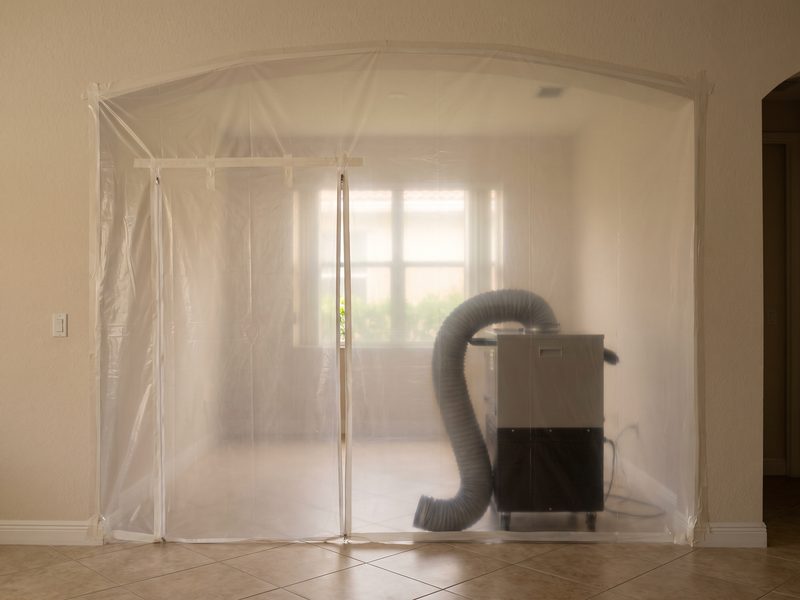
- Step 5 — Structural drying: deploy air movers and dehumidifiers and control the indoor environment with psychrometric monitoring.
- Step 6 — Verify dry: confirm framing and slab have reached documented drying goals with moisture meters before any reconstruction.
- Step 7 — Rebuild: only now install new drywall, insulation, and trim.
Why do flood cuts and verified drying have to come before any rebuild?
Flood cuts and verified structural drying must come before any rebuild because sealing new drywall over a wet wall cavity traps moisture against wood and paper — creating the exact dark, humid, undisturbed environment mold needs to thrive. Rebuilding first does not save time; it guarantees a second, worse demolition later.
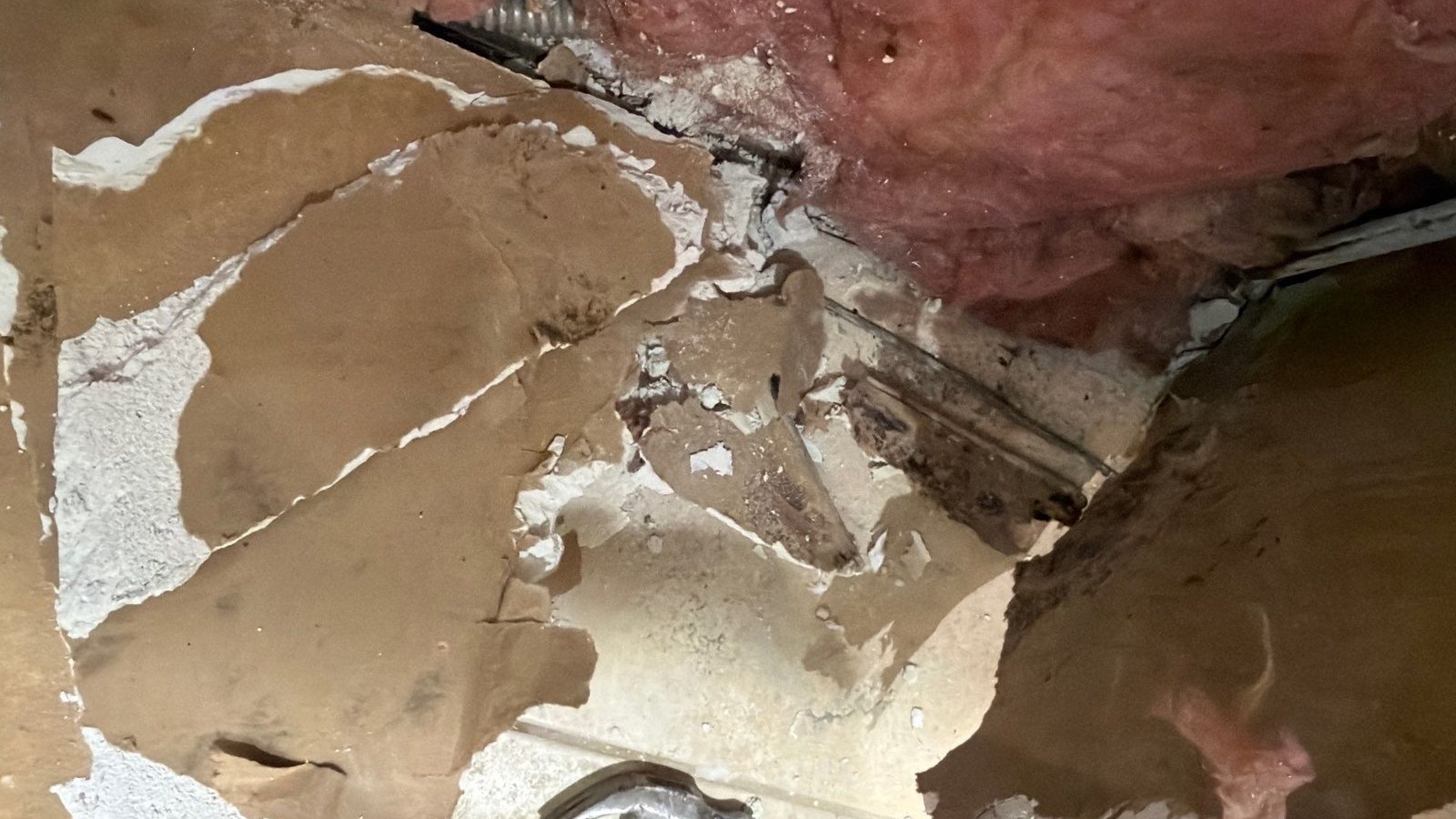
A flood cut is the deliberate removal of drywall (and the insulation behind it) to a set height above the waterline — commonly 12 to 24 inches above it, sometimes higher. There are two reasons for it. First, wet insulation loses its R-value and holds water indefinitely; it almost never dries acceptably in place and must come out. Second, opening the wall lets air movers and dehumidifiers reach the cavity and the bottom plate of the framing, which is where slab water wicks up and lingers.
Verified drying is the other half. Under ANSI/IICRC S500, the professional standard for water damage restoration, drying is not finished when surfaces feel dry to the touch — it is finished when moisture-meter readings confirm materials have returned to a documented drying goal for that structure. That distinction is everything. A wall can feel dry on the surface while the framing behind it still reads saturated.
This is why we keep daily moisture logs on every drying project. They tell us — and later tell your insurance carrier — that the structure genuinely reached target, not that someone guessed. If a contractor offers to close the walls back up within a day or two without meter verification, that is the moment post-storm mold is most likely to begin. Our water damage restoration and mold remediation teams treat the dry-out and the rebuild as two separate, sequenced phases for exactly this reason.
How does South Florida's humidity make post-storm mold worse?
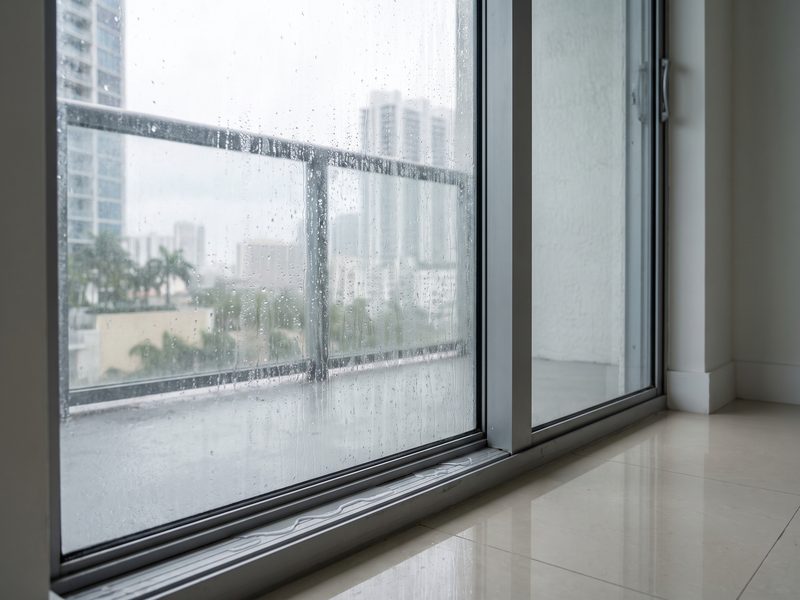
South Florida's climate makes post-storm mold worse because the ambient air is already too humid to dry a wet building passively — and hurricanes strike during the most humid months of the year. With outdoor humidity routinely at 60-80% and often higher after a storm, opening windows and running fans does almost nothing; the air outside holds nearly as much water as the air inside.
Drying is fundamentally about moving water from wet materials into drier air and then removing that air's moisture. When the surrounding air is saturated, materials have nowhere to release their water. This is why professional structural drying relies on dehumidification — commercial dehumidifiers that actively pull moisture out of a controlled, closed environment — rather than ventilation. In a Miami September, a box fan and an open window can actually make a wall wetter.
Psychrometry, the science of air and moisture, drives the whole process. A restoration technician tracks temperature, relative humidity, and grains of moisture per pound of dry air to confirm the equipment is creating a drying gradient. Manage the environment correctly and materials give up water on a predictable curve; ignore it and the structure stalls at 'damp' for weeks — which is precisely long enough for mold to take hold.
The practical takeaway for homeowners anywhere in Miami-Dade, Broward, or Palm Beach counties: do not rely on the weather to dry your home. The weather is the problem. Controlled, equipment-driven drying is the only reliable path, and it needs to begin quickly.
What water categories apply after a hurricane, and why do they matter?
After a hurricane, floodwater is almost always treated as Category 3 — the most contaminated class under IICRC S500 — because storm surge and ground flooding carry sewage, chemicals, and microbial hazards. The water category matters because it decides what can be cleaned and saved versus what must be removed, and it directly shapes both the mold risk and the health risk.
IICRC S500 defines three categories of water, and knowing which one you're dealing with tells you how aggressive the removal has to be. Wind-driven rain through a broken window may start as Category 1 (clean), but water degrades in category as it sits or contacts contaminated materials. Rising floodwater is Category 3 from the start.
Category 3 water is why porous materials touched by hurricane flooding — drywall, carpet, pad, and insulation — are generally removed rather than dried and reused. It is also why post-storm cleanup should follow contamination-control protocols, not just a mop and a fan. Attempting to salvage sewage-contaminated materials to save money is how homeowners end up with both mold and a lingering health hazard behind their walls.
| Category | Description | Typical hurricane source | Porous materials |
|---|---|---|---|
| Category 1 | Clean water from a sanitary source | Fresh rain through a broken window, caught early | May be dried in place if addressed fast |
| Category 2 | Significantly contaminated ('gray water') | Category 1 water left to sit or contact contaminants | Often removed; case-by-case |
| Category 3 | Grossly contaminated ('black water') | Storm surge, ground flooding, sewage backup | Removed under contamination-control protocols |
Can you stop hurricane mold yourself, or do you need a professional?
You can handle very minor, clean-water dampness yourself if you act within hours and the affected area is small, but hurricane flooding — especially Category 3 water over a slab — calls for professional structural drying and, if growth has started, professional mold remediation under ANSI/IICRC S520. The deciding factors are water category, how long materials stayed wet, and whether you can verify the structure is actually dry.
Homeowners can and should do meaningful first-response work in the first hours: document everything with photos and video for your claim, remove standing water you can safely reach, get soaked contents up off the floor, and pull back wet rugs and furniture. These actions genuinely shrink the mold window.
But there are hard limits to DIY. Most homeowners cannot see inside a wall cavity, cannot measure the moisture content of framing, and do not have commercial dehumidification sized for a saturated slab in South Florida humidity. Without those, 'dry to the touch' becomes a false finish line — and the mold that follows shows up weeks later inside the wall you thought you saved.
Call a professional when floodwater contacted the structure, when drywall or insulation is saturated, when you smell a musty odor, or when visible mold already exists. Established growth under S520 requires containment, controlled removal of affected materials, and verification — not bleach and a sponge, which typically treats the surface while the colony continues in the material behind it. When in doubt after a South Florida storm, the safe move is a professional assessment while the drying window is still open. You can reach our team any time through our contact page or at (786) 213-9489.
How does insurance and documentation work for hurricane mold in Broward, Miami-Dade, and Palm Beach?
For hurricane mold claims in Miami-Dade, Broward, and Palm Beach counties, thorough documentation is what protects you — and in South Florida the coverage distinction between wind-driven rain and flood matters enormously. Restoration Doctor of South Florida bills you, the homeowner, directly and hands you a carrier-ready claim file: an Xactimate line-item scope, CompanyCam photo documentation, and daily moisture logs. We work for you, not for your insurance company.
The coverage distinction is critical here. Damage from wind-driven rain (water entering because wind first breached the roof or a window) is generally handled under a homeowners or windstorm policy, while rising surface water and storm surge fall under separate flood coverage — often a National Flood Insurance Program policy. Because a single flooded home can involve both, clear documentation of how and where water entered can make the difference in what gets paid.
The mold-lag timeline also creates a documentation trap. Because mold appears weeks after the storm, an insurer may question whether the growth is storm-related or the result of homeowner delay. A contemporaneous record — dated photos, moisture readings taken during drying, and a clear scope tied to the storm event — connects the later mold to the original hurricane water.
That documentation is built into how we work, not added on afterward. Daily moisture logs prove the drying effort, photos capture conditions before demolition, and a line-item scope gives your adjuster exactly what they need to evaluate. You stay in control of the claim, we hand you the file, and the paperwork supports the work. See our storm response capabilities on our storm damage restoration page, and explore the areas we cover on our locations page.
- Photograph and video everything before removing or cutting anything.
- Note the water's point of entry — roof, window, or rising ground water — to support the wind-vs-flood coverage question.
- Keep receipts for emergency measures like tarps, pumps, and temporary lodging.
- Request daily moisture logs so the drying effort is documented.
- Get a line-item scope you can hand directly to your adjuster.