Water Damage From a Leaking Air Conditioner in Florida

BYSteve Jafari, General ManagerMIAMI-DADE & BROWARD
Air conditioner water damage in Florida is usually caused by a clogged condensate drain line, a failed condensate pump, or a frozen evaporator coil — not the refrigerant. Because South Florida humidity routinely runs 60-80%, trapped water can start growing mold in 24-48 hours. The right response is to stop the leak, clear the drain line, and dry the structure to documented IICRC S500 moisture goals before the overflow happens again.
Call (786) 213-9489What causes water damage from a leaking air conditioner in Florida?
Most air conditioner water damage in Florida comes from condensate — the normal water your AC pulls out of humid indoor air — escaping its drain system instead of flowing outside. When that water backs up or overflows, it saturates the air handler platform, drywall, insulation, and whatever sits below or beside the unit. This is a drainage problem, not a refrigerant leak, and it is extremely common in a climate where a single system can condense many gallons of moisture a day.
Your air handler cools warm, humid air across a cold evaporator coil. Water condenses on that coil, drips into a drain pan, and exits through a PVC condensate line to the outside or to a condensate pump. Any break in that chain — a clog, a crack, a disconnected joint, a dead pump, or a frozen coil that thaws all at once — sends water where it does not belong.
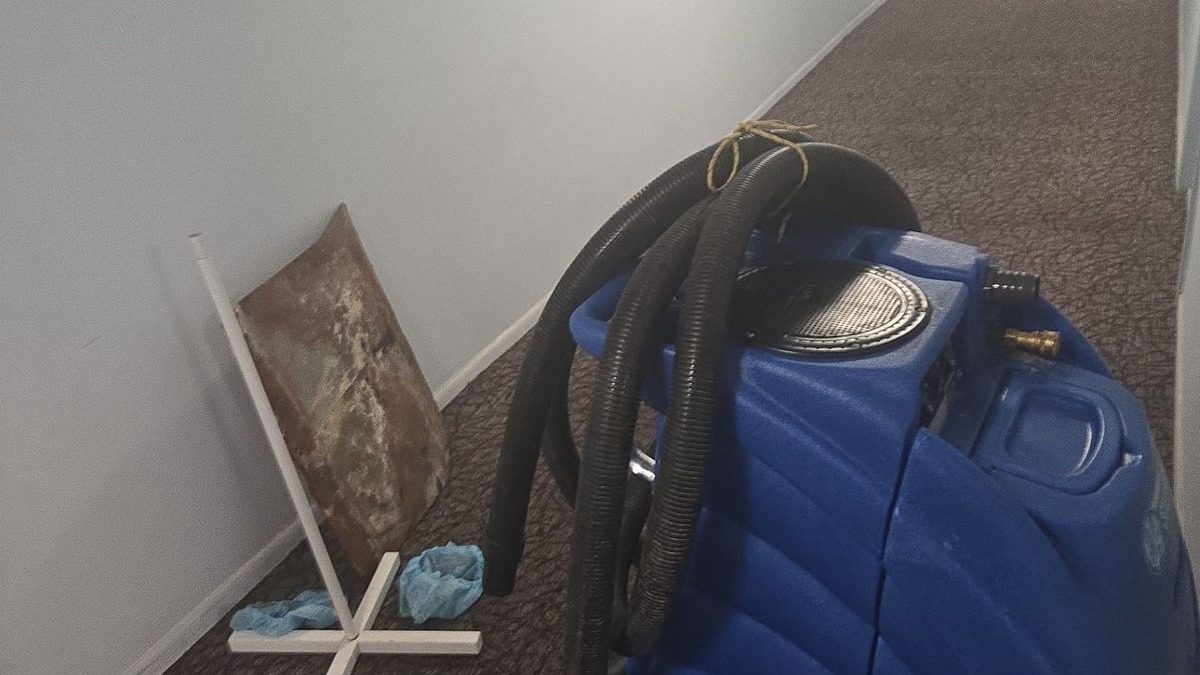
In South Florida the volume is relentless. With outdoor humidity routinely between 60 and 80 percent, an AC runs hard and produces condensate almost continuously during the warm months, so even a slow, partial blockage turns into a steady leak that soaks materials for days before anyone notices. In high-rise condos across Miami-Dade and Broward, the air handler often sits in an interior closet, which means an overflow can travel into hallway carpet, shared walls, and even the unit below before the first stain shows.
- Clogged condensate drain line — algae, dust, and biofilm block the PVC pipe
- Failed or unplugged condensate pump on attic and closet air handlers
- Frozen evaporator coil that thaws and overwhelms the drain pan
- Rusted or cracked drain pan that no longer holds water
- Disconnected or improperly sloped drain line that leaks at the joint
- Dirty air filter restricting airflow and freezing the coil
Why does an AC condensate drain line clog so often in South Florida?
Condensate drain lines clog frequently in South Florida because warm, damp, dark PVC pipe is an ideal home for algae, mold, and bacterial biofilm, which build into a slimy plug that stops drainage. The same humidity that makes your AC produce so much water also feeds the organisms growing inside the drain line.
Dust and debris pulled through the air handler settle in the drain pan and combine with that biological growth to form a dense clog, usually near the trap or the exterior termination. Once the line is blocked, condensate has nowhere to go but up and over the edge of the pan.
Many systems have a safety float switch that cuts the AC off when the pan fills — the better outcome, since a warm house beats a flooded one. But plenty of older or improperly installed units have no working float switch, so the first sign of a clog is a water stain on the ceiling or a soaked closet floor. Because a South Florida AC may run ten months of the year with barely a break, the line never gets a chance to dry out, and biofilm growth is essentially year-round.
What are the warning signs of AC water damage before it becomes a flood?
The earliest signs of air conditioner water damage are usually subtle: a musty smell near the air handler, water pooling around the indoor unit, or a brown ring forming on the ceiling below an attic system. Catching these early is the difference between a minor repair and tearing out drywall.
Rising indoor humidity even while the AC runs is another red flag — it can mean the system is short-cycling or the coil is freezing, both of which precede a condensate overflow. If your AC suddenly shuts off on a hot day and you find standing water in the drain pan, a float switch has done its job and the line is clogged.
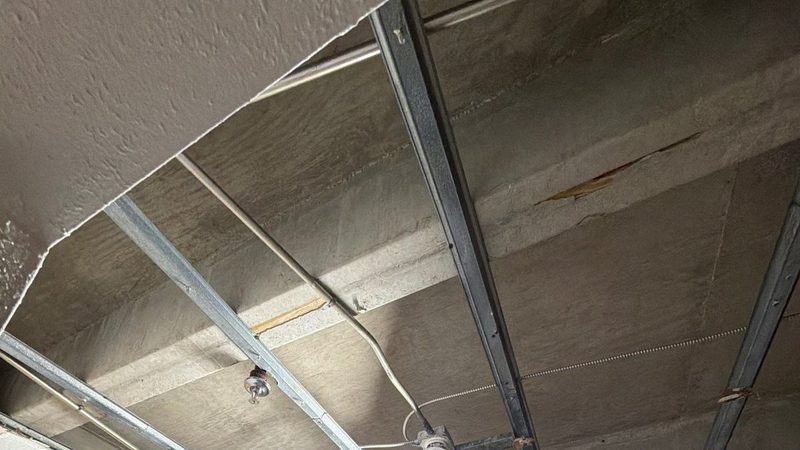
Because the air handler is often tucked in an attic, garage, or utility closet, damage can spread behind walls and under flooring before it is visible. South Florida homes are slab-on-grade, so escaping water does not drain down into a lower level — it spreads sideways across the slab, wicking up into baseboards and the bottom edge of drywall. If you smell mildew or see discoloration spreading near the unit, treat it as an active leak and investigate immediately.
- Musty or mildew odor near the air handler or return vent
- Water stains or brown rings on the ceiling below an attic unit
- Standing water in or around the drain pan
- Peeling paint, bubbling drywall, or warped baseboards near the unit
- Higher-than-normal indoor humidity while the AC is running
- The AC repeatedly shutting itself off (float switch tripping)
How fast can mold grow from an AC leak in Florida's humidity?
Mold can begin growing on wet drywall, wood, and insulation within 24 to 48 hours in South Florida's humid climate — and an AC condensate leak is a near-perfect mold incubator. The water supply is constant, the air handler area is dark and poorly ventilated, and the surrounding materials — paper-faced drywall, wood framing, dust — are organic food sources.
This matters because condensate leaks are often slow and hidden, meaning the moisture may have been feeding growth for days or weeks before you find it. By the time you notice the musty smell, colonization inside the wall cavity or above the ceiling may already be underway.
Under the ANSI/IICRC S520 mold remediation standard, the correct response is to correct the moisture source first, contain the affected area, and physically remove contaminated materials rather than simply spraying or painting over them. Drying the surface after a long-running leak does not resolve growth that has taken hold inside the structure, which is why a professional assessment matters once mold is visible or suspected. You can read more about how we approach this on our /services/mold-remediation page.
Is AC condensate water clean, or is it a contamination risk?
Fresh AC condensate starts as relatively clean water (IICRC S500 Category 1), but it does not stay that way for long once it sits in a drain pan or soaks into building materials. The organic slime inside the drain line, plus dust and microbial growth, can degrade it quickly.
Under the S500 water damage standard, water is categorized by its level of contamination, and a loss can deteriorate over time. Category 1 is clean water from a sanitary source. Category 2 carries significant contamination and can cause illness if ingested, and Category 3 is grossly contaminated. A condensate leak that has fed microbial growth, passed through a filthy drain pan, or soaked porous materials for days can deteriorate from Category 1 to Category 2.
The practical takeaway: the longer the water sits, the more aggressive the cleanup must be. A leak caught in the first hours may only need extraction and drying, while a leak that has been running for a week often means removing saturated drywall and insulation that can no longer be salvaged or safely dried in place.
| Category | What it means | Typical AC leak scenario |
|---|---|---|
| Category 1 | Clean water from a sanitary source | Fresh condensate caught quickly at the drain pan |
| Category 2 | Significantly contaminated (gray water) | Condensate that sat in a dirty pan or soaked materials for days |
| Category 3 | Grossly contaminated | Long-standing leak with heavy microbial growth or mixed contamination |
What should you do right now if your air conditioner is leaking water?
If your air conditioner is leaking water, turn the system off at the thermostat, soak up standing water, and stop the source before you worry about repairs. Shutting the AC down stops it from producing more condensate while you address the clog or pump failure.
Next, move furniture, electronics, and anything porous away from the wet area and get air circulating if it is safe to do so. Do not ignore a ceiling stain spreading below an attic unit — that drywall is holding water and can fail suddenly. If the leak has soaked carpet, baseboards, or wall cavities, the structure needs to be professionally dried to measurable moisture goals, not just wiped down.
You can usually clear a minor clog yourself by locating the condensate line cleanout and using a wet/dry vacuum on the exterior termination. But if water has already reached drywall, flooring, or insulation, call a restoration professional before hidden moisture turns into mold. Restoration Doctor of South Florida answers at (786) 213-9489 and serves Miami-Dade and Broward counties.
- Turn the AC off at the thermostat to stop producing condensate
- Soak up or vacuum standing water and move belongings to a dry area
- Locate the drain line cleanout and clear it if you can do so safely
- Document everything with photos and video before you clean up
- Call for professional drying if walls, ceilings, flooring, or insulation are wet
How does professional water damage restoration for an AC leak work?
Professional restoration for an AC leak follows the IICRC S500 process: stop the moisture source, measure how far the water spread, remove unsalvageable materials, and dry the structure back to a documented drying goal using controlled airflow and dehumidification. The goal is not just a dry surface but a dry wall cavity, subfloor, and framing.
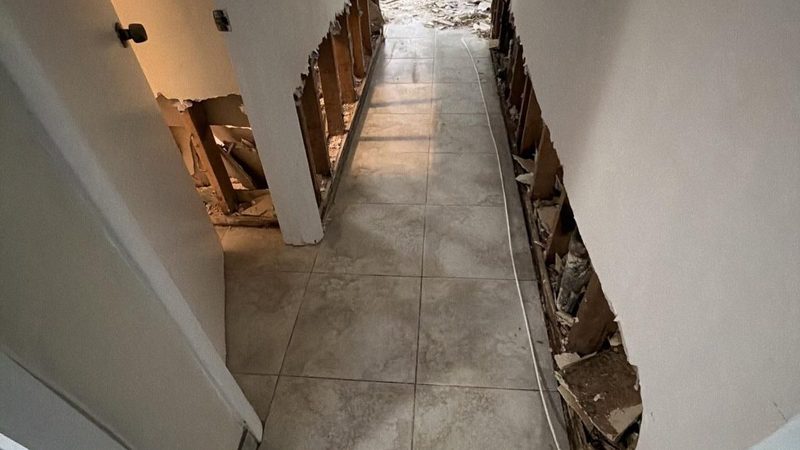
It starts with inspection and moisture mapping. Using moisture meters and sometimes thermal imaging, a technician traces how far the condensate traveled — which is often farther than the visible stain suggests. Saturated drywall, wet insulation, and swollen baseboards that cannot be dried in place are removed. Then air movers and dehumidifiers create the psychrometric conditions needed to pull moisture out of the remaining structure, with moisture readings logged daily until materials reach their drying goal.
If mold is already present, containment and the S520 protocol come into play so spores are not spread through the home's air. Throughout the job, the affected materials, readings, and scope are documented. Our /services/water-damage-restoration team handles this end to end, and because we work for you — not your insurance company — we bill you directly and hand you a carrier-ready claim file with a line-item Xactimate scope, CompanyCam photo documentation, and daily moisture logs you can submit to your carrier.
Does homeowners insurance cover AC water damage in Florida?
Homeowners insurance in Florida often covers the resulting water damage from a sudden AC leak — the ruined drywall, flooring, and ceiling — while typically excluding the repair or replacement of the AC unit itself. Coverage usually turns on whether the leak was sudden and accidental versus gradual and the result of neglected maintenance.
A clogged condensate line that overflows and soaks a ceiling is frequently treated as a covered water-loss event. But if an adjuster determines the leak was long-standing and ignored — the classic gradual-damage exclusion — the claim can be denied. This is exactly why documentation matters, and why it helps to involve a restoration company that records the condition, moisture levels, and scope from day one.
We invoice the homeowner directly and provide a thorough, carrier-ready claim file so you can present a clear, well-supported claim. We do not bill your insurance company — our job is to work for you, document the loss properly, and dry your home correctly. If you want help understanding the process, reach out through our /contact page or review common questions on our /faq.
Keep in mind the real cost of restoration depends on how much water escaped, how far it spread, how much material had to be removed, and how many days of drying the structure needs — figures that only come together after an on-site inspection. Work like this typically runs in the thousands, and a legitimate number follows an in-person assessment, not a phone guess.