Water Damage in a Miami Short-Term Rental: Who Pays, and What the Downtime Costs

BYSteve Jafari, General ManagerMIAMI-DADE, BROWARD & PALM BEACH
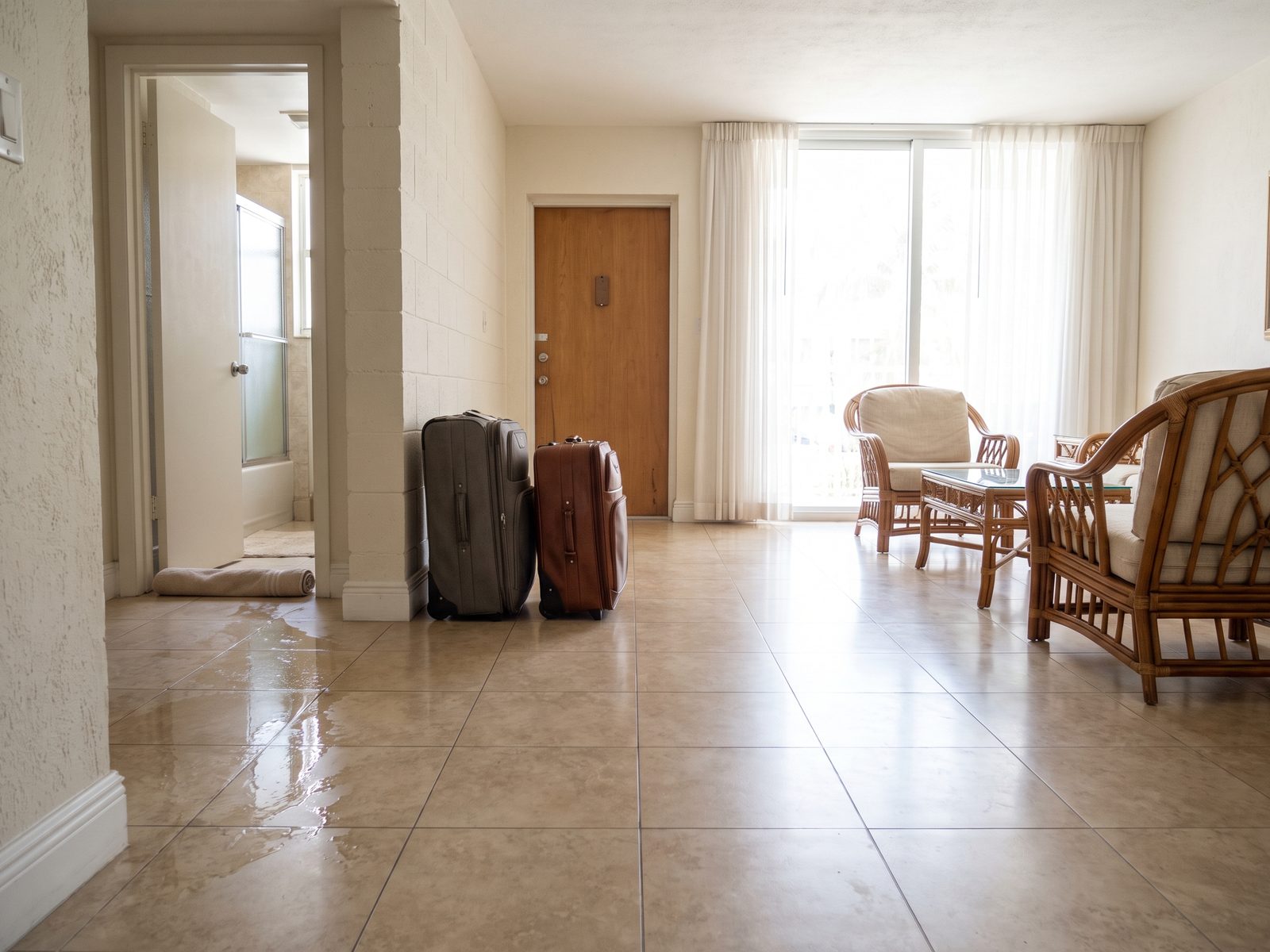
A flooded short-term rental sits inside four possible coverage sources: a personal policy, a short-term-rental policy, platform host protection and the association's master policy. Running the unit as a business can push a personal policy out of the picture, and downtime is the loss most operators fail to document.
Call (786) 213-9489Who pays when a Miami short-term rental floods?
Water damage in an Airbnb or another short-term rental is normally paid by the unit owner's own property insurance, but only when that policy was written with paying guests in mind. A personal homeowners or condo policy often was not, and that single fact decides more of these claims in South Florida than any argument about the leak itself.
Four sources can pay, and they rarely pay the same things. The unit owner's policy handles the interior and its contents. A dedicated short-term-rental or landlord policy adds the business side, including lost rental income. A booking platform's host protection sits on top of the guest relationship. The association's master policy covers the building and, depending on the declaration, some of what is inside your walls.
The wet part of the problem is the part everyone sees. The other half is the calendar. Guests get relocated, the listing goes dark, and high-season nights that were already booked disappear while the unit dries. Those two losses travel on different parts of the policy and need separate paperwork from day one.
| Coverage source | What it usually addresses | Where it usually stops |
|---|---|---|
| Personal HO-3 or HO-6 | Owner-occupied dwelling or unit interior and personal contents | Business use of the unit, which can void the claim outright |
| Short-term-rental or landlord policy | Rented unit, furnishings, liability and loss of rental income | Flood and often mold beyond a small sublimit, unless endorsed |
| Booking platform host protection | Damage tied to a specific guest stay, on the platform's own terms | Anything outside a booked stay, plus long exclusion lists |
| Association master policy | Building structure, common elements, and building-side plumbing | Unit contents, upgrades and, in many buildings, interior finishes |
| Separate flood policy | Rising water and storm surge, which property policies exclude | Contents unless separately purchased, and business income |
What is a business-use exclusion, and when does it bite?
A personal property policy is priced for a home, not a business. Most carry language that limits or excludes loss arising out of a business conducted on the premises, and renting a unit to a rotating set of paying guests reads as a business to almost every carrier. The exclusion does not have to mention nightly rentals to apply.
It usually bites at the worst moment. The claim is filed, the adjuster asks a routine question about who was in the unit, and the answer turns a covered water loss into a coverage investigation. Listing screenshots, cleaning schedules and platform payout records are all easy for a carrier to find.
There is a second trap for owners who converted a home they used to live in. The policy that was correct when the unit was a residence stays in force and keeps renewing quietly. Nothing on the renewal notice announces that the use has changed, and nothing forces the carrier to notice until a claim lands.
- Ask your agent in writing whether short-term rental is permitted under the policy as written.
- Keep the written answer with the declarations page, not in an email thread you cannot find later.
- Tell the agent how often the unit is rented and whether it is ever owner-occupied.
- Re-ask the question every renewal, because form language changes between policy periods.
How does a true short-term-rental policy differ from an HO-6?
An HO-6 is a condo unit-owner form. It is built around the gap between what the association's master policy covers and what an owner owns inside the walls, and it assumes the owner lives there. It covers the interior, personal property and personal liability, and it usually offers loss of use so the owner has somewhere to stay while repairs happen.
A short-term-rental or landlord form starts from a different assumption: the unit produces income. That changes three things. Liability is written for guests rather than household members. Contents are treated as furnishings placed for commercial use. Loss of use becomes loss of rental income, which pays for nights you could not sell rather than a hotel room for you.
Mold is worth a separate look before you buy. Many South Florida property forms cap fungus and mold remediation at a small sublimit, and in a climate this humid year-round, the EPA advises acting on wet materials within 24 to 48 hours before mold begins to grow. Ask what the sublimit is and whether it can be raised.
What does platform host protection actually cover?
Booking platforms offer host protection programs, and they are not insurance policies in the way owners assume. Terms change, coverage sits behind conditions, and the program is usually tied to a specific booked stay rather than to the unit in general. Read the current terms on the platform itself before you rely on any summary, including this one.
The common shape is this. Something a guest does during a stay may be addressed. A supply line that fails two days after checkout, with no guest in the unit, generally is not. Damage that developed slowly, wear on furnishings, and anything the platform classifies as a maintenance issue tend to sit outside the program as well.
Treat host protection as a backstop, not a foundation. It may cover a deductible, a furniture replacement or a specific guest-caused incident. It is not built to carry a structural water loss, a mold remediation or several weeks of blocked nights, and no operator should be planning around it as if it were.
- Open a platform claim on the stay it belongs to, before the next guest arrives.
- Message the guest through the platform so the conversation is on the record.
- Keep the platform claim and the insurance claim running separately, with the same evidence.
Where does the association's master policy start and stop?
In a Miami Beach or Brickell building, the line between the association and the unit owner is drawn by the recorded declaration, not by common sense. Some declarations stop the master policy at the unfinished surfaces of the walls, floors and ceilings. Others include original builder-grade finishes but exclude every upgrade an owner installed later.
Cause of loss usually decides who opens the first claim. Water that traveled from a common element, a building riser or a roof is typically an association issue. Water from a fixture, a hose or an appliance inside the unit is typically the owner's. Between those two clean cases sits a large middle ground, which is where plumbing behind a wall and drain lines shared between stacked units live.
Deductibles matter more than most owners expect. Master policy deductibles on coastal buildings can be large, and many declarations allow the association to allocate that deductible back to the unit or units involved. A loss can be covered by the master policy and still leave the owner paying a significant share of it.
How is loss of rental income calculated on blocked nights?
Loss of rental income is usually calculated from what the unit would have earned during the period of restoration, less expenses that stopped while it was closed. Carriers want evidence, not estimates, and the evidence is the booking record: confirmed reservations that were canceled, the nights the calendar was blocked, and the rates those nights were actually carrying.
The period of restoration is the part operators lose money on. It is normally defined as the time reasonably required to repair or replace the damage, not the time it actually took. A week lost waiting for an association to approve a contractor, or a delay while a second carrier decides who owns the loss, may fall outside the period a carrier will pay for.
Seasonality is a legitimate argument when it is documented. South Florida rates move sharply between high season and the slow months, and an operator with clean historical records for the same calendar weeks in prior years has something concrete to show. Without that history, the carrier will price the nights conservatively.
- Export the booking calendar and all confirmed reservations on the day of the loss.
- Save every cancellation message, refund record and payout statement as a file, not a screenshot in a phone.
- Log the date each blocked night begins and the date the listing goes live again.
- Ask your carrier in writing how it defines the period of restoration on your form.
What if the damage was caused by a guest?
Guest-caused damage adds a third party to a two-party problem. An overflowed tub, a shower left running, a toilet blocked by something that should not have been there: these are the ordinary causes of a short-term-rental water loss. Each one is traceable to a person who has already checked out.
The security deposit is the first and smallest layer, and on most platforms it is not a held sum of money at all. It is a claim process with a deadline. The platform's host protection program sits behind it, again on the platform's own terms. Behind both sits your property policy, which may respond to sudden and accidental water discharge regardless of who caused it.
Sudden and accidental is the phrase to watch. A tub left running is usually sudden. A slow drip around a shower pan that soaked a subfloor over weeks is usually not, and carriers routinely deny long-term seepage even when a guest technically caused it. That distinction often turns on moisture readings and the condition of the materials, which is why documentation taken before demolition matters.
How do building bylaws and the local ordinance change the outcome?
A flooded rental raises a compliance question at the same moment it raises a coverage question. Miami Beach publishes its own short-term rental requirements, many buildings bar nightly rentals outright in their own documents, and municipal rules differ street by street across Miami-Dade, Broward and Palm Beach. Read the city's own short-term rental requirements page and confirm with its code compliance office rather than relying on a summary from a listing site.
The association layer is separate from the city layer and can be stricter. A declaration or a board rule can prohibit rentals shorter than a set term, require board approval of tenants, or limit the number of leases per year. None of that is overridden by a municipal rule that happens to allow nightly stays.
None of this is a reason to hide the use. It is a reason to confirm, in writing and before the next booking, that the unit is permitted to operate the way it operates. If the answer is unclear, that is a question for a licensed attorney familiar with local condominium and rental rules, not for a contractor.
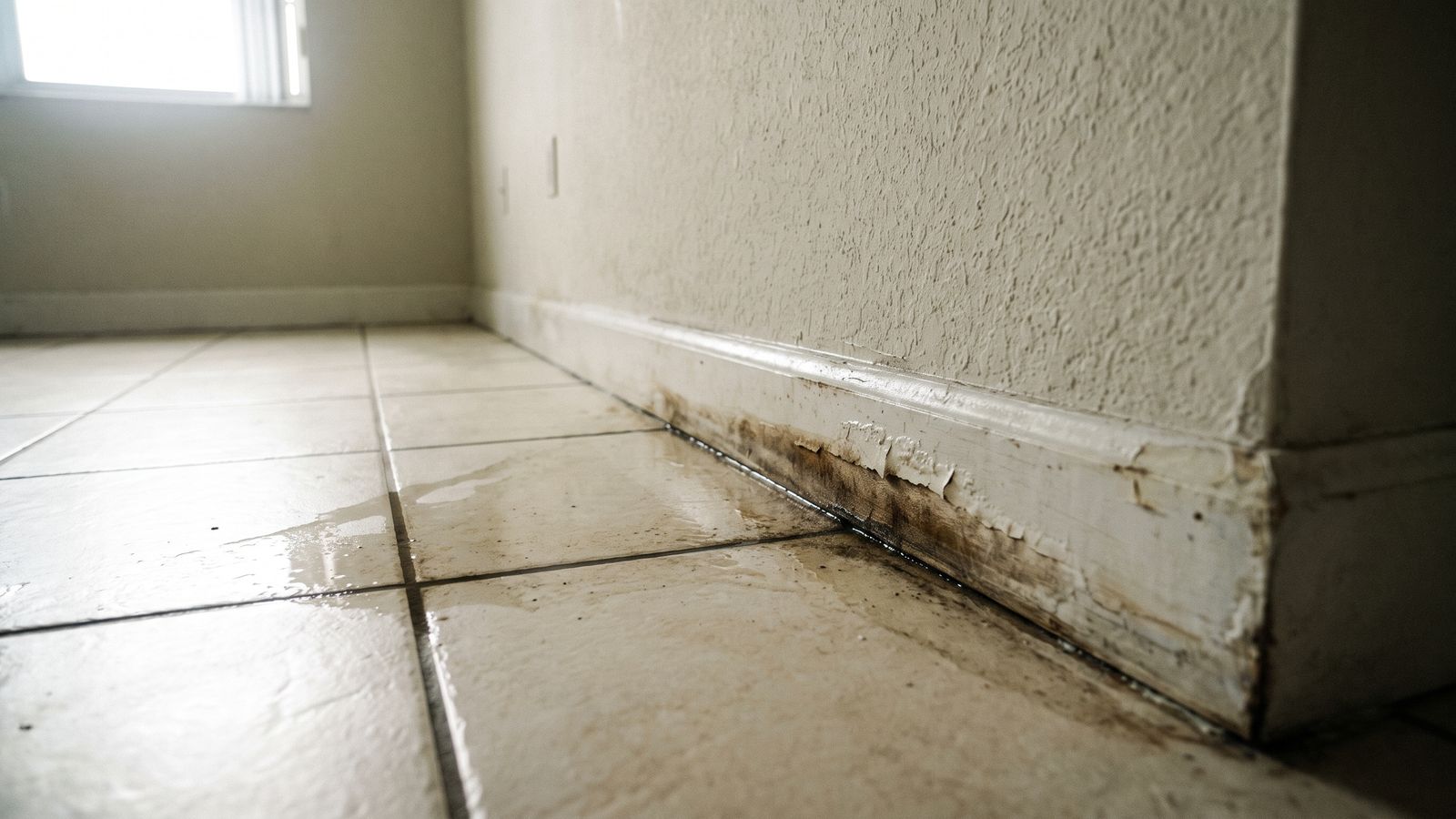
What should an operator photograph before guests are moved out?
The strongest claim file is built in the first hour, while the unit still looks the way the water left it. Once guests pack, once a cleaner mops, once anyone pulls a rug, the record of how far the water spread is gone. Shoot wide first so the room reads as a room, then move in close.
Photograph the source if it is safe to reach. A supply line, a hose connection, a failed valve or an overflowing fixture is the single most contested fact in these claims, and a clear frame of the component settles arguments that words do not. If a part is replaced, keep the failed part in a bag.
Do not skip the boring frames. Baseboards, the edge of the tile, the underside of a vanity, the closet floor on the shared wall, the hallway outside the door, and the ceiling of the unit below if the neighbor will allow it. Water travels along the path of least resistance, and in a slab building that path runs sideways under finishes.
- Wide shots of every affected room before anything is moved or cleaned.
- Close frames of the failed component, plus the part itself kept in a bag.
- Baseboards, tile edges, cabinet toe kicks and closet floors on shared walls.
- The hallway, the corridor carpet and the unit below where access allows.
- Booking calendar, canceled reservations and guest messages exported the same day.
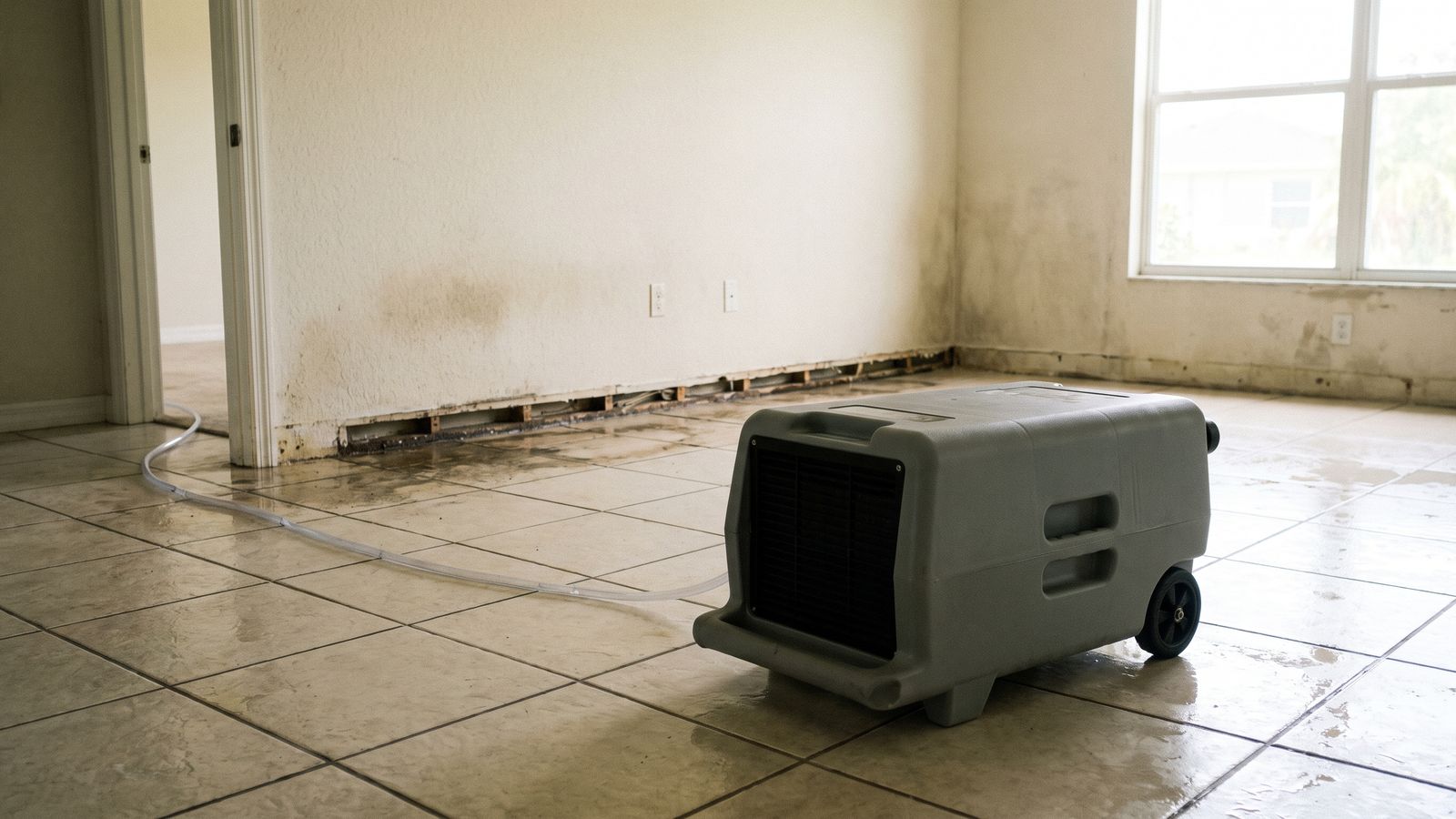
How do you get a unit back to rentable condition fastest?
Speed on a rental is a scheduling problem as much as a drying problem. Extraction and controlled drying to a verified standard is the technical half, and the IICRC S500 standard is what a professional crew works to. The other half is building access, association approvals, elevator reservations and the hours a management office allows work to happen.
Furnished units carry an extra step. Beds, upholstered pieces and rugs hold water and slow the room down, so contents are moved, blocked off the floor or taken offsite for cleaning before structural drying really starts. Handling them properly is also what protects the contents portion of the claim, since materials thrown in a dumpster before anyone documents them are difficult to recover later.
One thing to settle before work begins is money. Restoration Doctor bills you, the property owner, and hands you a carrier-ready claim file: a line-item scope, photo documentation and daily moisture logs your adjuster can read. We work for you, not for your insurance company. For the underlying question of what a standard homeowners policy does and does not cover before business use enters the picture, our sister site restorationdoctors.com covers whether a homeowners policy covers water damage.
- Call a restoration crew and the management office in the same few minutes.
- Block the calendar for a realistic window rather than reopening and canceling twice.
- Ask for daily moisture logs, because they are what a carrier reads when it questions the days.
| Source | What it covers | Where to read it |
|---|---|---|
| IICRC standards | S500 for water damage restoration and S520 for mold remediation | IICRC standards |
| EPA, mold | General guidance on mold, moisture and drying wet materials | EPA, mold |
| FEMA, flood insurance | What a flood policy covers and how it differs from a property policy | FEMA, flood insurance |
| City of Miami Beach | The city's own short-term rental requirements | City of Miami Beach |