Plumber, Roofer or Restoration Company? Who to Call First in South Florida

BYSteve Jafari, General ManagerMIAMI-DADE, BROWARD & PALM BEACH
A plumber stops the water, a restoration company removes it and dries the structure, and a roofer closes the envelope, so the right first call depends on whether water is still moving. In a South Florida condominium there is a fourth step, because the association's own vendor may have to touch a shared riser before any outside company is allowed to start.
Call (786) 213-9489Do I call a plumber or a water damage company first?
If water is still moving, call the plumber first. If the water has stopped and the building is wet, call the restoration company first. That single test answers the question of whether you need a plumber or restoration company on the phone right now, and it is the part most people get backwards at two in the morning. Both trades answer after hours, both use the word emergency, and only one of them can turn the water off.
The reason the order matters is that the two jobs run on different clocks. A plumber's clock stops when the leak stops. A restoration company's clock starts the moment the water lands and keeps running while the material sits wet. In South Florida that second clock runs fast, because the outdoor air stays humid for most of the year and indoor air has nowhere clean to dump moisture once the walls are saturated.
So the sequence is not plumber versus restoration company. It is plumber, then restoration company, with the second call placed while the first truck is still on its way. Nobody has to wait for the repair to finish before drying begins.
What does a restoration company do that a plumber does not?
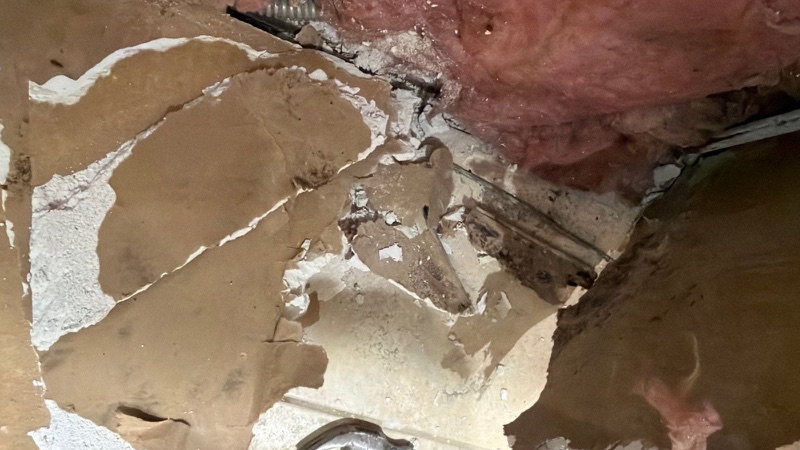
A plumber fixes the thing that broke. A restoration company deals with everything the water touched on its way out of that thing. Those are separate skills, separate tools and separate insurance conversations, and the overlap between them is smaller than most homeowners expect.
Water spreads along the path of least resistance. In a slab home that means under the tile bed and into the bottom of the drywall. In a high-rise it means along the concrete deck and into the unit next door. A moisture meter and a thermal camera map that spread, and without the map a repair gets made over material that is still wet.
Our sister company on the Restoration Doctor network published a longer explainer on what a mitigation company does that a plumber does not, step by step.
- Extraction: pulling standing water out of tile, carpet, pad and cavities before it wicks any further.
- Moisture mapping: meter and camera readings that define how far the water actually traveled, not how far the stain shows.
- Controlled demolition: removing wet baseboard, drywall or cabinet kick only where the readings say it is needed.
- Structural drying: air movers and dehumidifiers sized to the wet material, monitored daily against a dry standard.
- Documentation: daily moisture logs, photos and a line-item scope your carrier can actually read.
Which symptom points to which trade?
This is the decision tree in one table. Read down the symptom column, find the row that matches what you can see right now, and make the call in the second column. The third column is the call that usually follows within hours, not days.
| What you can see | Call first | Call next | Why that order |
|---|---|---|---|
| Water spraying, running or rising right now | Plumber | Restoration company | Nothing else matters until the source is off. Shut the valve yourself if you can reach it. |
| Water stopped, floors and walls are wet | Restoration company | Plumber, if the cause is unknown | The clock is now about drying time, and the source may already be fixed or may be rain. |
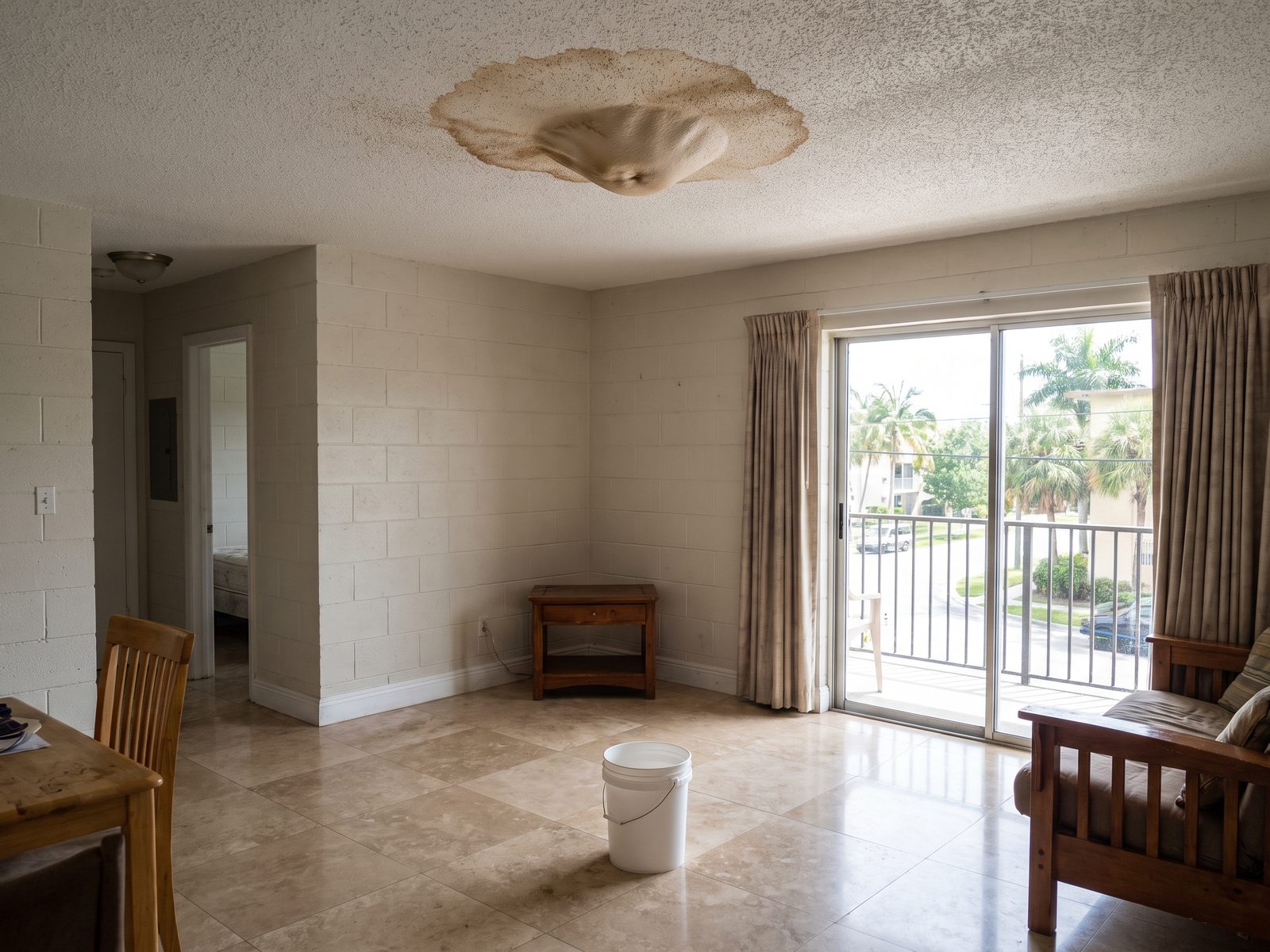
| Brown ring on the ceiling after a storm | Roofer | Restoration company | The envelope has to close before drying can hold, or the next band reopens the loss. |
| Ceiling wet with no rain and no appliance above | Plumber | Restoration company | A supply or drain line in the ceiling or the unit above is the usual source. |
| Wet ceiling in a condominium, source unknown | Building management | Plumber and restoration company | The association controls access to the unit above and to shared lines. |
| Musty smell, soft baseboard, no visible water | Restoration company | Plumber, if a hidden leak is found | You need the moisture map first to know whether anything is still leaking. |
| Sewage backing up into a tub or floor drain | Plumber | Restoration company | Contaminated water needs the line cleared, then handled as a sanitation job. |
| Rebuilding after the structure is dry | General contractor | Nobody, the sequence is over | Reconstruction is the last step, and it starts from documented dry readings. |
When do you need two trades on the same day?
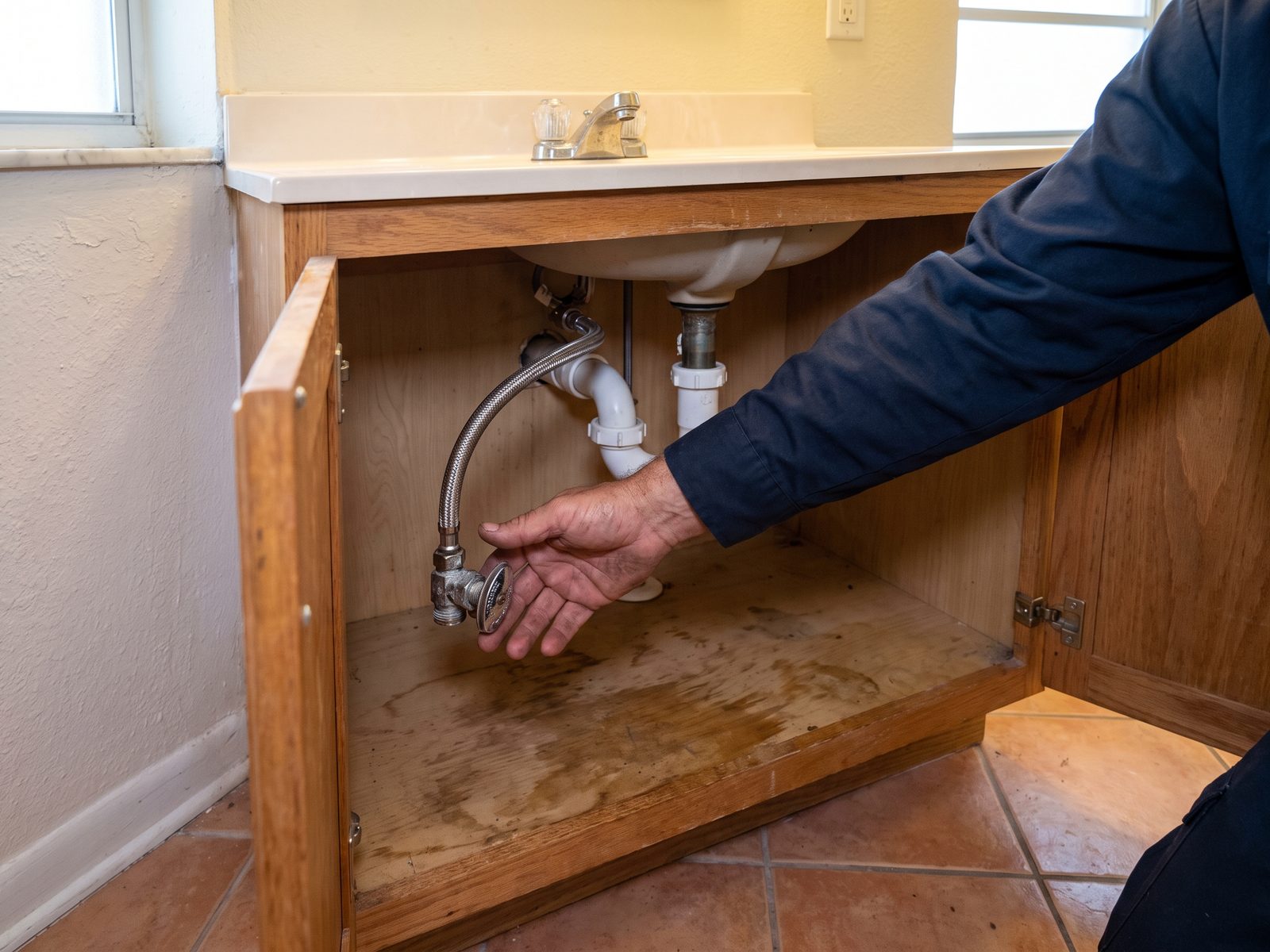
More often than the average homeowner assumes. A broken supply line under a vanity is a plumbing repair and a drying job at the same time, and the two do not conflict. The plumber needs the space under the cabinet. The restoration crew needs the rest of the room. Sequencing them on the same afternoon is normal, and it is the cheapest version of the job.
The version that costs money is the one where the plumber finishes, the homeowner mops the floor, and nobody calls anyone else until a smell shows up more than a week later. By then the drywall behind the vanity has been wet for days in warm humid air, the cabinet kick has swollen, and what would have been a short dry-out is now a removal and rebuild.
Who do I call for a ceiling leak in a condo?
Call building management first, then the restoration company, then the plumber. This is the branch of the tree that does not exist in a single-family market, and it is the one that catches Brickell and downtown Miami owners out. In a high-rise the water in your ceiling almost never originates in your unit, and the pipe it came from may not be yours to touch.
Shared risers, stacks and the lines inside common walls are association property in most recorded declarations. If the source sits in one of those, the association's own plumber may have to make the first cut, and an outside vendor who opens that wall first can create a liability argument nobody needs. Management also controls the thing you actually need most, which is access to the unit above.
None of that stops drying. Your unit is your unit, and extraction plus air movers inside your walls is your call to make. What management can dictate is equipment placement in corridors, elevator use for gear, freight elevator hours, quiet hours and whether a certificate of insurance is on file for the vendor. Ask for the building's vendor requirements in the first phone call, not on arrival.
Expect two claim tracks to open at once. Yours covers the interior of your unit under your policy, and the association's master policy covers whatever its declaration says it covers, which varies building to building. The two adjusters will eventually talk to each other, and the documentation that survives that conversation is the moisture log with dates on it.
- Notify management in writing, not only by phone, and ask them to log the time.
- Photograph the ceiling and the floor before anyone touches anything.
- Ask which vendor the association requires for shared plumbing, and whether your own crew needs a certificate of insurance on file.
When is the roofer the right first call?
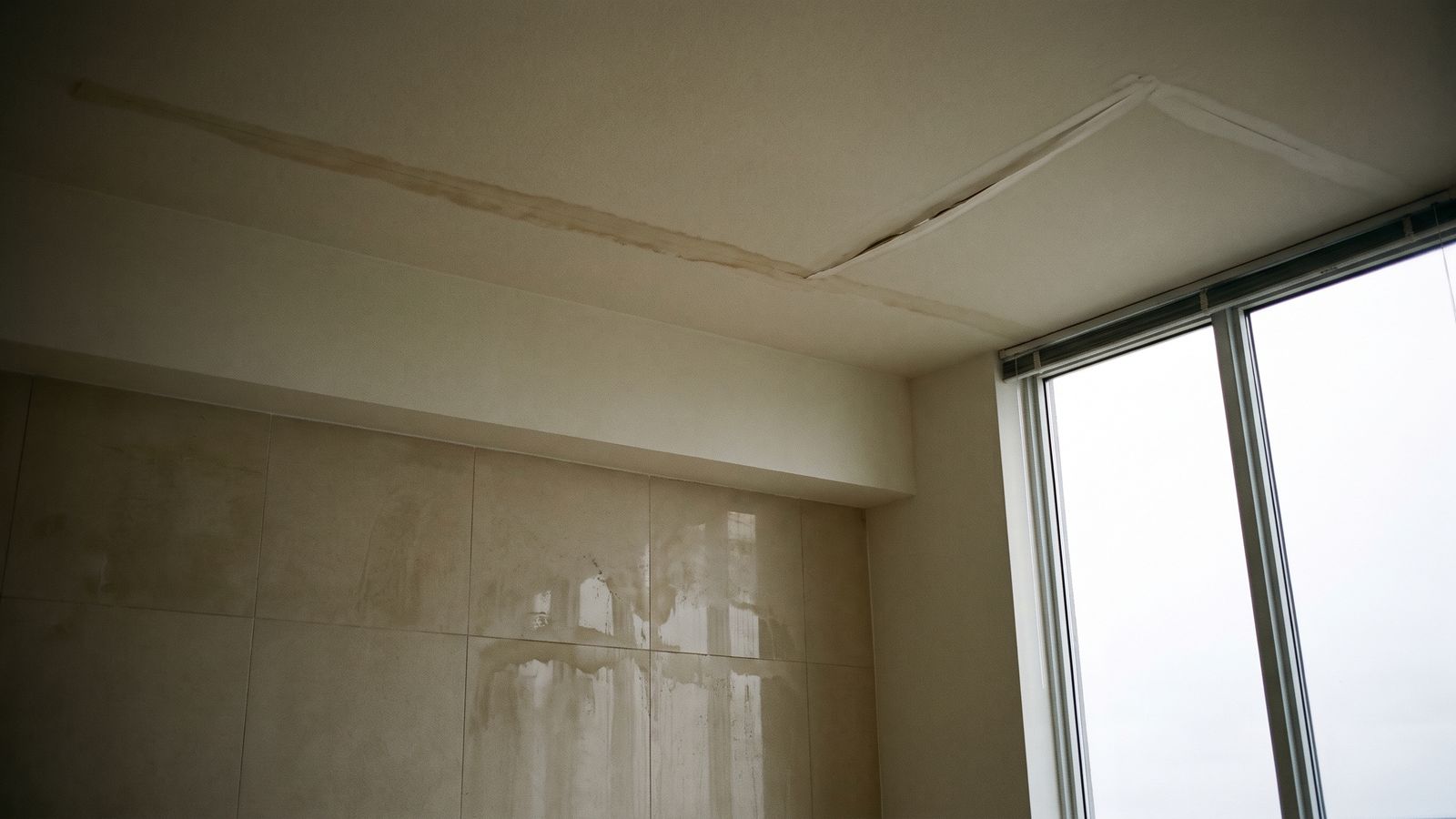
When the water arrives with the weather. A stain that appears during a storm, grows while the rain falls and stops growing when it passes is an envelope failure, and no amount of drying holds until the envelope closes. Wind-driven rain through a failed seal, a lifted tile or a clogged scupper will keep refilling the same ceiling cavity every band.
The practical order on a storm loss is tarp or dry-in first, then dry the inside. A roofer who can get a temporary cover on within the same day protects the drying work that follows. Outside a storm, the same logic applies to a leaking window or a failed balcony door threshold, where a waterproofing contractor plays the roofer's role.
One caution for a season of repeat storms. If every roofer is booked for days, drying does not have to wait. Interior drying can start under a temporary cover, and a restoration company can usually install one.
Where does a general contractor fit in?
At the end. A general contractor puts the building back, and that work starts after the structure reads dry, not before. The common failure is hiring a contractor on day two, because a contractor is the person who sounds like they can handle all of it, and then discovering the new drywall went over a wet stud bay.
There is a version where the contractor comes early, and it is a legitimate one. Structural damage, an unsafe ceiling, a collapsed soffit or anything that needs a permit and an engineer wants a licensed builder looking at it on day one. In Miami-Dade and Broward the permitting rules for structural work are their own process, and the county building department is the authority on what needs a permit.
Some companies do mitigation and reconstruction under one roof. Ask whether the drying documentation and the rebuild estimate stay separate line items, because your carrier evaluates them separately and a blended number invites a delay.
- Mitigation first: stop, extract, dry, document, verify dry.
- Reconstruction second: drywall, paint, flooring, cabinetry, trim.
- The handoff is a set of moisture readings that meet a dry standard, with dates.
What does the insurance side expect you to have done first?
Most homeowner policies carry a duty to protect the property from further damage after a loss, and your own policy language is where to confirm it. Carriers read that literally. Water left sitting for days while you gather three quotes reads as delay, and the damage that grew during the delay is the part that gets argued over later. Calling for mitigation quickly is not an insurance risk. It is the thing the policy asks you to do.
What a carrier wants to see afterwards is a before, a during and an after. Photographs from before anything was moved. Daily moisture readings that show the material drying toward a target rather than sitting. A line-item scope tied to those readings. That package is what turns a claim from a negotiation into a review.
On the money side, the honest framing is simple. We bill you, the homeowner, and hand you a carrier-ready claim file with the scope, the photos and the logs inside it. You stay the customer, which means the drying decisions are made against your building rather than against an adjuster's estimate. If the claim gets complicated, a licensed public adjuster or an attorney is the right person to bring in, and that is a decision worth making early rather than late.
What should I do in the ten minutes before anyone arrives?
The first few minutes matter more than the next few hours, and none of it requires a tool you do not own. Work in this order.
- 1. Kill the source. Shut the angle stop under the fixture, or the main near the water heater or the meter, and if it is a high-rise, tell the front desk immediately.
- 2. Kill the power to wet areas at the breaker if water is anywhere near an outlet, a floor lamp or an entertainment wall. Do not stand in water to reach a switch.
- 3. Photograph everything before you move it. Wide shots of each room, then close shots of the ceiling, baseboard, cabinet kick and any wet contents.
- 4. Get furniture legs off wet flooring. Aluminum foil or a plastic lid under each leg stops wood stain from bleeding into carpet and flooring.
- 5. Lift rugs, move boxes and pull anything paper or fabric out of the wet zone. Cardboard wicks fast and is usually the first thing lost.
- 6. Leave the air conditioning running and set it cool. Warm humid air is what turns a wet room into a mold problem, and the system is your only dehumidifier until equipment arrives.
- 7. Do not open windows. Outdoor air in South Florida is wetter than the air you are trying to dry, for most of the year.
- 8. Write down the time the leak started, the time you shut it off and who you called. That timeline becomes the first page of the claim.
How do I check that whoever shows up is licensed to do the work?
Florida licenses construction and remediation trades through the Department of Business and Professional Regulation, and DBPR runs a public license search that anyone can use from a phone. Type the company name or the license number the technician gives you, and read what comes back. You are checking three things: that the license exists, that it is active rather than expired or suspended, and that the category actually covers the work being proposed.
Ask for the number before work starts, not after. Ask separately for a certificate of insurance. General liability and workers compensation are what protect you if someone gets hurt in your home, and a condominium building will ask for the same document before it lets a crew through the loading dock.
For the technical side, ask which standard the drying plan follows. Water mitigation in the United States is written against IICRC S500, and mold work against IICRC S520. A crew that can name the standard and show you a daily moisture log is working to a method. A crew that cannot is guessing, and guessing in this climate is expensive.
- Florida Department of Business and Professional Regulation licensee search
- Sources: IICRC standards, including S500 for water damage restoration and S520 for mold remediation
- EPA guidance on mold cleanup in homes
- FEMA flood insurance guidance on what standard property policies exclude
- Miami-Dade County building and permitting information
- Restoration Doctor sister site on what a mitigation company does