King Tide Flooding in Edgewater Condo Parking Garages: What Can Actually Be Done?

BYSteve Jafari, General ManagerMIAMI-DADE, BROWARD & PALM BEACH
Condo parking garage flooding in Miami's Edgewater neighborhood during fall king tides is mostly caused by tidal backflow through storm drains, not rain. The saltwater it delivers is Category 3 floodwater under ANSI/IICRC S500, and it corrodes slabs, rebar, vehicles, and building equipment. Associations cannot stop the tide, but they can install backflow protection, relocate critical equipment, plan vehicle removal, and pre-arrange a fast saltwater wash-down and decontamination. Because king tides are predictable by date, preparation is the one flood hedge you can schedule.
Call (786) 213-9489Why do king tides flood condo parking garages in Edgewater, Miami?
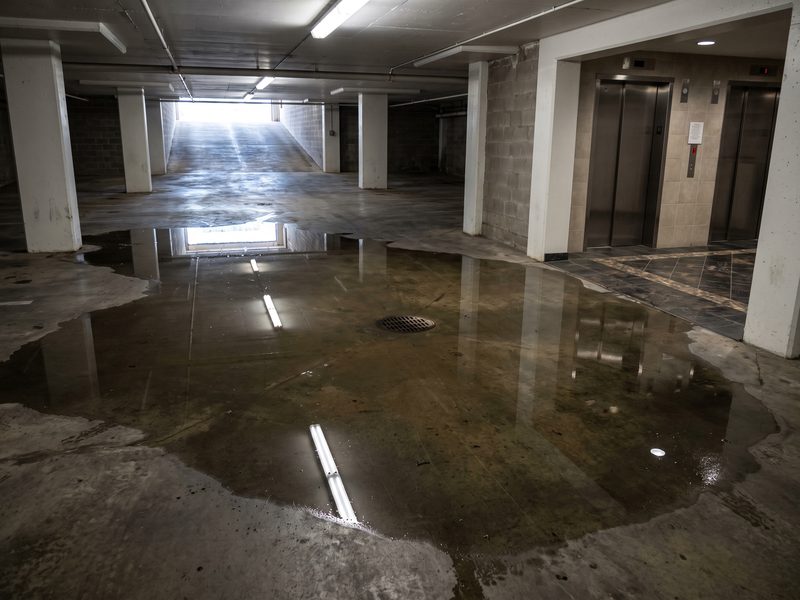
King tides flood Edgewater condo garages because the highest tides of the year push Biscayne Bay water up through low-lying storm drains and into ground-level or partly below-street-grade parking, even on a sunny day with no rain. This is often called sunny-day or nuisance flooding, but for a condo association with a garage full of vehicles and equipment, there is nothing minor about it.
A king tide is not a storm. It is an especially high astronomical tide, produced when the sun and moon line up with the Earth (often with the moon at its closest approach) and seasonal sea levels are already elevated. In South Florida the strongest of these arrive in the fall, with October commonly the peak. That makes them calendar-certain. You can look up predicted tide dates months ahead, which is rare for any flood risk.
Edgewater sits along Biscayne Bay, and many of its mid-rise and high-rise condominiums were built with parking at or near street grade, often with garage ramps that dip downward. Those design choices put the garage slab close to the same elevation as the water table and the storm drain outfalls. When the bay rises, the drainage system stops draining and starts filling.
This matters for planning. A hurricane is a probability. A king tide is a schedule. Even in a hurricane season forecast to be quiet, the fall tides still arrive, which makes tidal flooding the most dependable hazard a waterfront association can prepare for.
How does tidal backflow through storm drains flood a condo garage?
Tidal backflow happens when rising bay water enters the storm drain network through its outfalls, travels backward through the pipes, and surfaces through inlets, floor drains, and catch basins connected to your garage. The water comes up from below rather than running in from above, which is why a garage can flood while the sky is clear.
Storm drains are designed to move water downhill to the bay by gravity. When the bay's tide level equals or exceeds the elevation of the outfall, gravity no longer works in your favor. Water that would normally leave the system has nowhere to go, and the tide itself pushes water back up the line. Any garage floor drain tied to that system can become an entry point.
Associations often look for the cause on their own property first, but the system is usually shared. The municipal drain line, the street inlets, and your private garage drains may all be part of the same hydraulic network. That is why an association can do everything right inside the building and still see water arrive through a drain it does not own.
Common contributing conditions include the following:
- Storm drain outfalls sitting at or below high-tide elevation
- Garage floor drains or sump discharge lines tied into the tidal drainage network
- Missing, failed, or never-installed backflow preventers or check valves
- Ramp entrances that sit lower than the surrounding street, allowing street flooding to pour downhill into the garage
- Groundwater that rises with the tide and seeps through slab joints, cracks, and utility penetrations
Is saltwater flooding in a condo garage considered Category 3 water?
Yes. Under ANSI/IICRC S500, floodwater from the sea is treated as Category 3, grossly contaminated water. A garage adds oil, fuel residue, brake dust, and street runoff to the mix, and tidal water that comes through storm drains also picks up whatever is in the pipes and on the pavement along the way.
What confuses people is that king tide water can look clear. It often does at first. But clarity is not cleanliness. Seawater carries bacteria and organic material, and water pushed back through a municipal drain system may carry sediment and sewage-related contamination. Treat it as contaminated until a professional says otherwise.
In practical terms, Category 3 handling means personal protective equipment for anyone entering the water, controlled extraction, cleaning before disinfecting, and removal of porous materials that cannot be reliably decontaminated. In and around a garage, that typically affects stored items, cardboard, drywall in storage rooms, pipe insulation, and carpet or fabric in any attached spaces.
It also means the response should not be improvised by building staff with a wet vac and a hose. Pumping contaminated water without containment can spread it into elevator lobbies, stairwells, and mechanical rooms. A scoped Category 3 response keeps contamination where it already is and removes it in a controlled direction.
What does saltwater do to garage slabs, rebar, and building equipment?
Saltwater drives chloride into concrete, and chlorides corrode the steel reinforcement inside it. As rebar rusts it expands, cracking and spalling the concrete from within. In a garage that floods repeatedly, each tide can add to the damage, so the harm is cumulative rather than a one-time event.
Concrete is porous. When salty water soaks in and then evaporates, it leaves salt crystals behind in the pores. Those salts are hygroscopic, meaning they pull moisture out of the air, and South Florida's humid climate gives them plenty to work with, so a slab can stay damp and chemically active long after the water is gone. That is why a prompt fresh water rinse after a tide event matters. Removing surface salt before it dries and migrates deeper is far easier than trying to extract it later.
Equipment is often hit harder than the slab. Saltwater is highly conductive and corrosive, and it can ruin electrical components within hours. Places to inspect after a flood include:
- Electrical panels, switchgear, and sub-panels located on or near the garage level
- Elevator pits, controllers, and ground-floor machine components
- Fire pumps, sprinkler risers, and alarm panels
- Gate operators, access control, cameras, and license plate readers
- EV charging stations and their wiring
- Sump pumps, ejector pumps, and lighting at low levels
- Plumbing, conduit, and metal fasteners in contact with standing water
What should happen to flooded vehicles in a condo garage?
Flooded vehicles should not be started, and owners should be told to have them towed and inspected as soon as it is safe to do so. Saltwater that reaches engine components, wiring harnesses, or control modules can cause damage that worsens the longer the vehicle sits, and trying to start a submerged car can cause further mechanical failure.
Electric and hybrid vehicles deserve extra caution. A high-voltage battery exposed to saltwater can present a fire or shock risk, sometimes after a delay. Owners should follow the manufacturer's guidance, and the association should consider whether a flooded EV needs to be moved promptly out of the building. A tow operator familiar with high-voltage vehicles is the right call.
For associations, the vehicle issue is as much about logistics and liability as it is about cars. A garage with abandoned flooded vehicles cannot be properly cleaned, and fluids leaking from them continue to contaminate the slab. Good practice includes a documented notification process, a reasonable timeline for removal, and photos of vehicle positions before cleanup begins.
Vehicle damage is generally an owner-level insurance matter, typically handled under the comprehensive portion of an auto policy rather than the association's property policy. Owners should check their own coverage. The association should avoid promising anything about vehicle reimbursement unless its attorney has reviewed the governing documents.
What can a condo association actually mitigate, and what can't it?
An association cannot stop the tide, change the elevation of the bay, or fix a municipal storm drain it does not own. What it can do is reduce how much water enters the garage, protect the equipment and structure that matter most, and shorten the time between flooding and cleanup. That is real mitigation, even if it is not prevention.
The most useful way to think about it is control versus exposure. Associations control what is inside their property line, such as backflow valves on private drain lines, equipment elevation, and response plans. They do not control the public drainage network, so they should document each event with dates, photos, and water levels and raise it with the city or county. A documented pattern is more persuasive than a single complaint.
Measures within an association's reach include:
- Having a licensed professional evaluate and install backflow preventers or check valves on private drain lines
- Evaluating temporary or permanent flood barriers at ramp entrances and doorways, with engineering review
- Relocating or elevating electrical equipment, controllers, and valuables out of the flood zone where feasible
- Sealing slab penetrations and cracks to limit groundwater seepage
- Adopting a king tide event plan with vehicle notices, closure procedures, and contractor contacts
- Scheduling post-event fresh water rinses and chloride-aware slab maintenance
- Reviewing the master policy, flood coverage, and deductibles before the water arrives
| Factor | Can the association control it? | Practical response |
|---|---|---|
| Tide height and timing | No | Use published tide predictions to schedule preparation |
| Public storm drain outfalls | No | Document events and escalate to the municipality |
| Private garage drain lines | Yes | Backflow preventers, check valves, professional inspection |
| Ramp and entrance flooding | Partly | Engineered barriers, grading review, closure procedures |
| Equipment location | Yes | Elevate or relocate where feasible, protect critical systems |
| Vehicle removal | Partly | Notices, deadlines, and documented procedures |
| Post-flood cleanup speed | Yes | Pre-arranged professional response and contact plan |
What is the right response after a king tide floods the garage?
The right response, in order, is to make the area safe, document everything, remove the contaminated water, rinse the salt from surfaces, clean and disinfect, and inspect for hidden damage in adjoining spaces. Speed matters because salt, moisture, and humidity begin working on metal and concrete immediately, and mold can begin growing within roughly 24 to 48 hours in damp, enclosed adjoining spaces.
Start with safety. Keep people out of standing water until electrical hazards are addressed, since energized equipment in saltwater is dangerous. Then document the event with timestamped photos and notes on water depth, affected equipment, and vehicles before anything is moved.
A garage is usually open to the air, so the work is less about structural drying and more about extraction, wash-down, and decontamination. The adjacent spaces are where moisture can linger: storage rooms, mechanical rooms, stairwells, elevator lobbies, and ground-floor units. Those areas may need moisture mapping and controlled drying following ANSI/IICRC S500 principles, and mold risk is evaluated under ANSI/IICRC S520 if damp materials stay wet.
Restoration Doctor of South Florida responds 24/7 across Miami-Dade, Broward, and Palm Beach counties, and we work for you, not your insurance company. We bill the property owner or association directly and provide a carrier-ready claim file with an Xactimate scope, CompanyCam photo documentation, and daily moisture logs, so the paperwork supports whatever claim your policy allows.
| Step | What happens | Why it matters |
|---|---|---|
| 1. Safety | Isolate power, restrict access, wear PPE | Saltwater and electricity are a dangerous combination |
| 2. Documentation | Photos, water depth, equipment and vehicle positions | Supports claims and association records |
| 3. Extraction | Controlled removal of contaminated water | Stops spread into lobbies and shared spaces |
| 4. Fresh water rinse | Flush salt from slab, walls, and fixtures | Limits chloride absorption and ongoing corrosion |
| 5. Cleaning and disinfection | Remove residue, treat surfaces per Category 3 protocols | Addresses bacteria, oils, and organic material |
| 6. Adjacent space check | Moisture mapping in rooms and units near the garage | Catches hidden water before mold starts |
| 7. Equipment inspection | Licensed trades assess electrical and mechanical systems | Prevents failures and safety hazards |
Who pays for king tide garage flooding in a condo?
Who pays depends on the policy, and the key issue is that tidal flooding is typically treated as flood, not as wind-driven rain. Standard condo and homeowner policies commonly exclude flood, so coverage often depends on a separate flood policy, and the association and each unit owner may hold different coverage.
In South Florida the distinction between wind-driven rain and flood matters enormously, and tidal inundation sits on the flood side. The association's master policy, any flood policy it carries, the unit owner's HO-6 policy, and the owner's auto policy each cover different pieces. The governing documents then decide who is responsible for the garage, common elements, and limited common elements.
Do not assume coverage either way. Read the actual policies, note deductibles and sublimits, and ask the broker or an attorney how a king tide event would be classified. Early documentation and a clear scope of work make any later conversation with a carrier far easier.
Our role is to restore the property and give you clean records. We bill you, the property owner or association, directly. That keeps the decisions about the work in your hands, while the carrier-ready claim file we build gives you what you need to pursue reimbursement where coverage applies.
How should an Edgewater association prepare before the fall king tides?
Prepare by checking the published tide predictions for your dates, inspecting drains and backflow protection, protecting equipment, notifying residents, and lining up a restoration contractor before the water arrives. Because king tides are predictable, a plan made in September costs far less than a scramble made in October.
A practical preparation timeline starts weeks ahead. Have a licensed plumber confirm that private drain lines and any check valves are working, and clear debris from garage drains and nearby inlets. Test sump and ejector pumps and confirm that backup power is in place for life-safety systems.
Next, communicate. Send residents the predicted high-tide dates, ask owners to move vehicles and stored items from low areas, and explain what the association will and will not do. Clear written notice protects residents and reduces disputes afterward.
Finally, have the response lined up. Save a restoration contact, keep the property manager, engineer, insurance broker, and electrician numbers in one place, and photograph the garage in its normal condition so any later damage is easy to compare. If you want a post-event cleanup plan in place before the next tide, call Restoration Doctor of South Florida at (786) 213-9489 and our team can walk through a response plan for your building.
The bottom line is that king tide flooding in Edgewater garages is a chronic exposure, not a one-off emergency. Associations that treat it as a recurring operational risk, with engineering review, equipment protection, and a ready response plan, spend less and lose less than those that wait for each event to surprise them.